
Post-Flood Mold Assessment in Kingsburg
Certified post-flood mold assessment in Kingsburg and surrounding areas. Independent inspections, accredited lab analysis, clear written reports. Call (559) 296-2088.
Mold doesn’t wait for the drywall to feel dry. Within 24 to 48 hours of a flood, spores already present in your home’s dust and building materials can begin colonizing wet framing, insulation, and subfloor cavities, often in spaces you can’t see and a moisture meter can’t reach from the surface. A post-flood mold assessment answers the question that a visual inspection alone never can: is the microbial load in this structure still within normal limits, or has colonization already started behind the walls?
What Post-Flood Mold Assessment actually involves
A post-flood mold assessment is a structured combination of moisture mapping, surface sampling, and air quality testing performed after flood or water intrusion events. It is not a general home inspection, and it is not the same as a mold remediation job, the assessment’s purpose is to establish whether mold growth is present, where it is concentrated, and what species are involved, so that any remediation scope is based on data rather than guesswork.
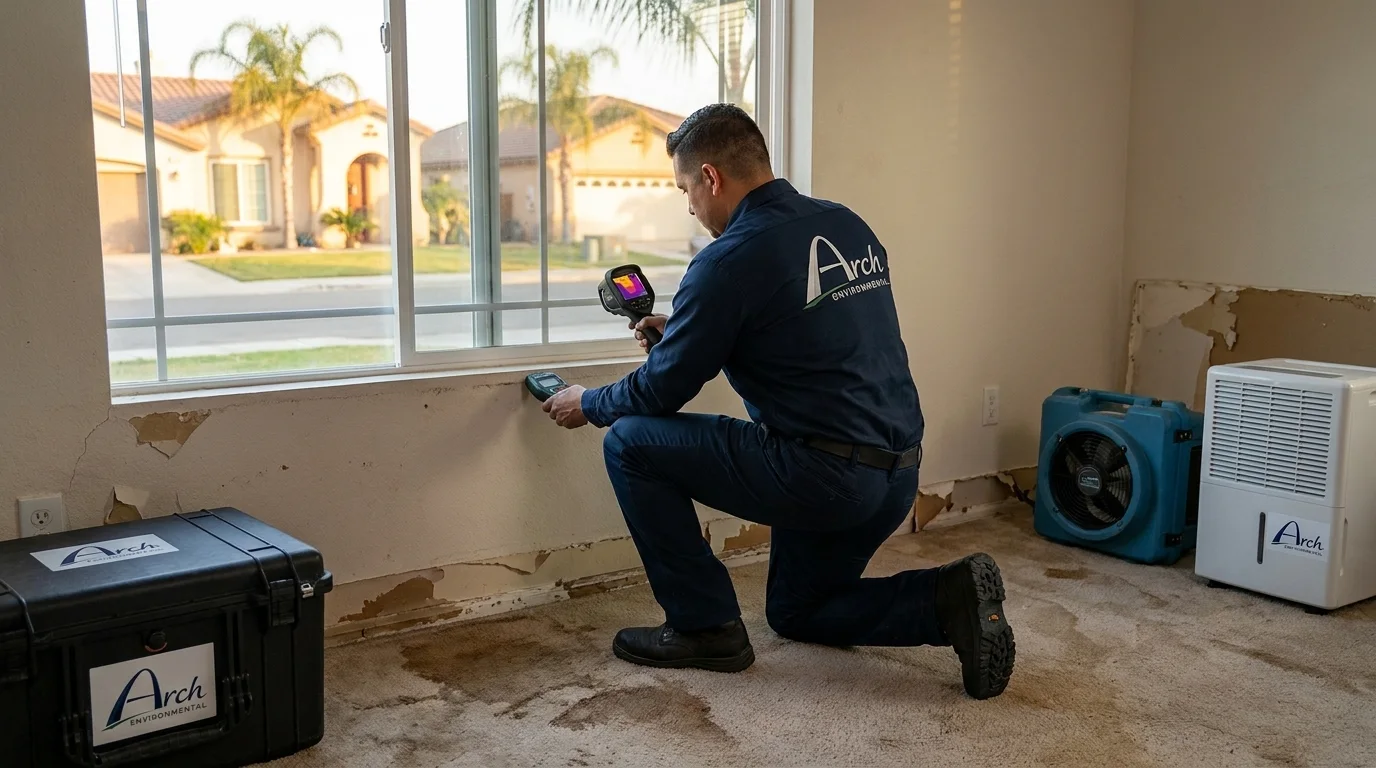
The work typically involves a calibrated thermal imaging camera to locate moisture pockets behind finished surfaces, a pin-type and pinless moisture meter array to map saturation gradients across wall assemblies and flooring systems, and air sampling using viable or non-viable spore-trap cassettes drawn at a calibrated flow rate. Surface swab or tape-lift samples are collected where visible growth or staining is observed. All samples are submitted to an accredited third-party laboratory, and the resulting report documents species identification, spore counts, and comparison to outdoor control samples collected the same day.
Timeline from site visit to written report typically runs three to five business days depending on laboratory turnaround. Rush analysis is available when the loss is active or an insurance adjuster is waiting on scope.
Our process
-
Pre-entry review and scope confirmation. Before entering the structure, we review the loss history, flood source (clean water, grey water, or sewage), duration of saturation, and any drying already performed. This shapes where we sample first and which laboratory panel is appropriate.
-
Moisture mapping across all affected assemblies. Using thermal imaging and calibrated moisture meters, we document saturation in walls, ceilings, subfloors, and crawl spaces. Readings are logged by location and material type, producing a moisture map that becomes part of the written report and the insurance file.
-
Air sampling, affected zones and control. Spore-trap air samples are collected inside each affected room and in at least one unaffected interior zone. An outdoor control sample is always collected the same day. Without that baseline, elevated indoor counts have no meaningful reference point.
-
Surface sampling where visual indicators are present. Any discoloration, staining, or suspected growth receives a tape-lift or swab sample. We document the location, substrate, and approximate affected area for each sample in the chain-of-custody record.
-
Written assessment report with remediation scope guidance. The final deliverable is a written report that includes the moisture map, laboratory results, species identification, interpretation of findings relative to AIHA and EPA guidance, and, where remediation is warranted, a scope of work recommendation that remediators and insurance adjusters can act on directly.
What separates a good post-flood mold assessment from a bad one
The most common failure in post-flood mold assessment is surface-only inspection. A structure can read within acceptable moisture limits at the drywall face while the wood framing behind it remains saturated enough to sustain active colonization. Thermal imaging and deep-probe moisture readings are not optional steps, they are how you find the loss that the surface conceals.
A second common problem is sampling without a control. Indoor spore counts are only meaningful when compared to an outdoor baseline collected the same day under similar weather conditions. An assessment that reports raw indoor counts without that reference gives the insurance adjuster nothing to work with and gives the homeowner no real answer.
Third: species identification matters. Elevated counts of common outdoor genera like Cladosporium carry a different remediation implication than elevated Stachybotrys or Chaetomium, which are strongly associated with chronic moisture and cellulose degradation. A report that lists only total spore counts without genus-level identification is not a complete assessment.
Insurance adjusters reviewing mold claims look for chain-of-custody documentation on every sample, a clear outdoor control, moisture readings by location and material, and a remediation scope tied directly to the laboratory findings. A report missing any of those elements typically triggers a supplement request that delays the claim.
Arch Environmental Group holds a Certified Asbestos Consultant and Lead Inspector Assessor credential, and our microscopists carry NIOSH 582 certification, the same analytical training standard used for laboratory fiber and spore identification.
What does Post-Flood Mold Assessment cost?
Typical costs for a post-flood mold assessment depend on the size of the affected area, the number of samples required, and whether rush laboratory turnaround is needed. Most homeowners pay somewhere in the ranges below, these are industry-typical figures, not a quote from Arch Environmental Group.
| Scenario | Typical industry range |
|---|---|
| Single room, limited sampling (3–5 samples) | $300 – $600 |
| Multi-room assessment with moisture mapping (6–10 samples) | $600 – $1,200 |
| Full-structure assessment after major flood (10+ samples) | $1,000 – $2,500 |
| Rush laboratory turnaround added to any scope | $150 – $400 additional |
| Re-clearance testing after remediation | $250 – $700 |
Every loss is different, Arch Environmental Group provides a written scope before work begins so there are no surprises. Homeowners insurance often covers mold assessment costs when the mold growth is a direct result of a covered peril such as a burst pipe or storm flooding; coverage for assessment triggered by long-term neglect or pre-existing conditions is typically excluded, so reviewing your policy language before the adjuster visit is worth doing.
Seasonal and regional considerations
In California’s San Joaquin Valley, the mold risk window after a flood is compressed by the region’s heat. Summer interior temperatures in Kingsburg and surrounding communities regularly exceed conditions that accelerate spore germination and mycelial growth, meaning the 24-to-48-hour colonization window cited in laboratory studies can effectively shrink in a hot, humid post-flood structure. Conversely, the Valley’s dry summers mean that structures that are opened up and dried aggressively can sometimes recover faster than in coastal or high-humidity climates, but only if drying begins promptly and is verified by measurement rather than assumption.
Winter storm events, less frequent but increasingly significant in recent years, carry their own risk: homes closed up against the cold trap moisture longer, and heating systems can create warm, damp microclimates inside wall cavities that surface readings miss entirely.
Service area
Arch Environmental Group is based in Kingsburg, CA and serves property owners throughout the surrounding San Joaquin Valley communities, including Fresno, Selma, Reedley, Visalia, Hanford, Clovis, and Tulare. City-specific service pages link back to this page for full process and technical detail.
If you are trying to determine whether mold has taken hold after a flood, or whether a structure that was dried is actually clear, call (559) 296-2088 to schedule an air quality test and moisture mapping inspection. We document the findings, prepare the report, and give you and your adjuster something concrete to act on.
Frequently Asked Questions
Does homeowners insurance cover a post-flood mold assessment?
How soon after a flood should a mold assessment be done?
What's the difference between an air sample and a surface sample, and do I need both?
Can a structure look and smell fine but still have a mold problem worth assessing?
What does the written assessment report actually include, and who uses it?
Looking for the best post-flood mold assessment company in Kingsburg?
Arch Enviornmental Group LLC provides post-flood mold assessment in Kingsburg, CA and the surrounding area, and has served local property owners since 2026. Customers rate us 5.0 out of 5 stars across 34 Google reviews. Call (559) 296-2088 to schedule post-flood mold assessment or request a free estimate.
Schedule Post-Flood Mold Assessment
Independent, lab-verified testing across Kingsburg and California's Central Valley.
Related Coverage
- Our Environmental Testing Services
- Contact Arch Enviornmental Group LLC
- Post-Flood Mold Assessment in Clovis
- Post-Flood Mold Assessment in Dinuba
- Post-Flood Mold Assessment in Fowler
- Post-Flood Mold Assessment in Fresno
- Post-Flood Mold Assessment in Reedley
- Post-Flood Mold Assessment in Sanger
- Post-Flood Mold Assessment in Selma
- Post-Flood Mold Assessment in Visalia
- How Soon Should You Test for Mold After Water Damage?