
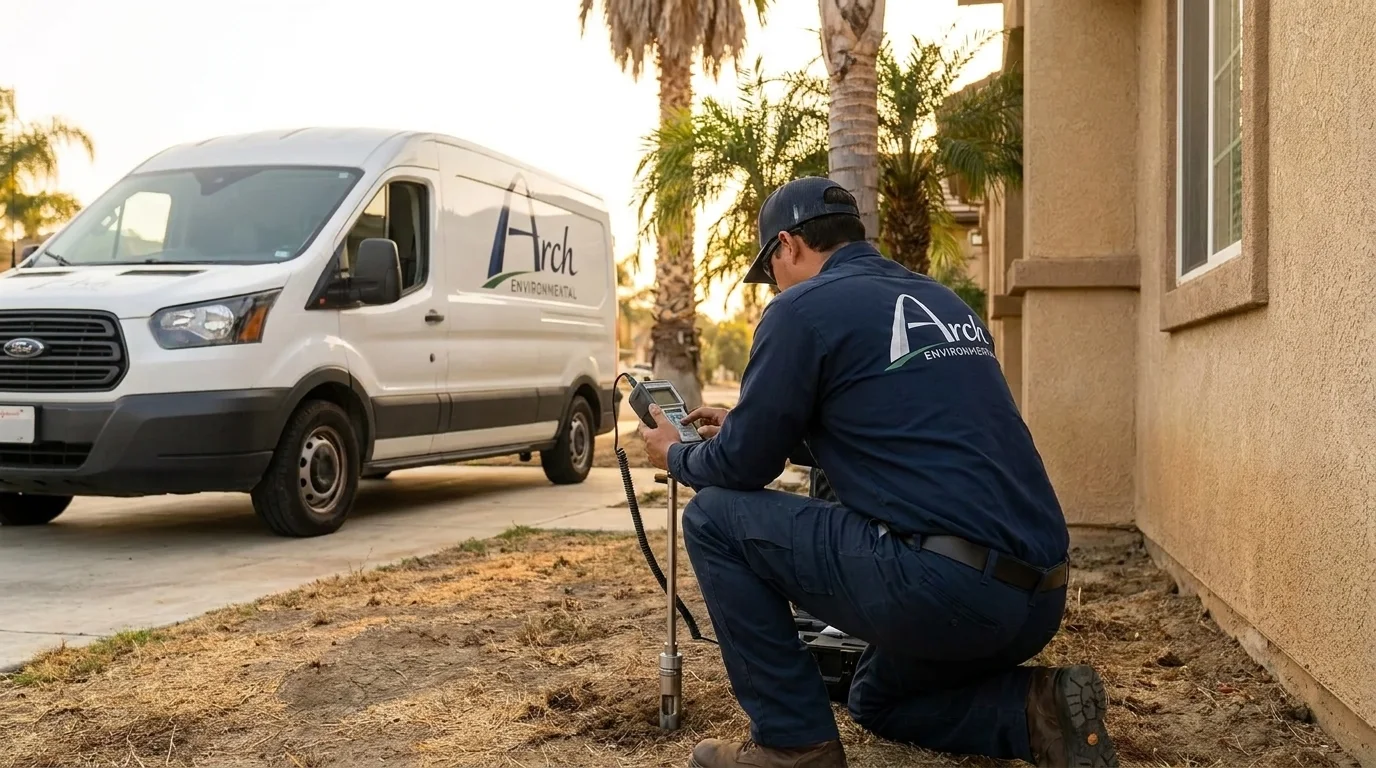
Environmental Site Assessments in Kingsburg
Certified environmental site assessments in Kingsburg and surrounding areas. Independent inspections, accredited lab analysis, clear written reports. Call (559) 296-2088.
When a commercial property changes hands, gets refinanced, or enters a development deal, lenders and buyers need to know what they’re actually acquiring, not just the building, but the ground beneath it and the regulatory history attached to it. An environmental site assessment answers that question before it becomes a liability. A missed underground storage tank, an undisclosed dry-cleaning operation from three decades ago, or a prior industrial tenant can turn a promising acquisition into a six-figure remediation problem. Getting the assessment right, and documented correctly, is what protects the transaction.
What Environmental Site Assessments actually involve
An ESA is a structured investigation governed by ASTM International standards, specifically ASTM E1527-21 for Phase I and ASTM E1903-19 for Phase II. These aren’t informal walkthroughs. They follow a defined methodology that lenders, attorneys, and regulators recognize and rely on.
Phase I Environmental Site Assessment is a records-and-reconnaissance process. It involves reviewing historical aerial photographs, Sanborn fire insurance maps, city directories, regulatory agency databases, and chain-of-title documents to identify Recognized Environmental Conditions (RECs), any indication that hazardous substances may have been released on or near the property. A site visit documents current conditions: staining, stressed vegetation, vent pipes, fill areas, or equipment that suggests past or present contamination. No soil or groundwater sampling occurs at this stage.
Phase II Environmental Site Assessment is triggered when a Phase I identifies RECs that warrant further investigation. This phase involves physical sampling, soil borings, groundwater monitoring wells, soil vapor extraction points, or bulk material sampling, analyzed by an accredited laboratory. The goal is to determine whether contamination is present, at what concentrations, and whether those concentrations exceed regulatory screening levels set by the California Department of Toxic Substances Control (DTSC) or the State Water Resources Control Board.
Timeline varies by scope. A Phase I on a straightforward commercial parcel typically takes seven to fourteen business days from engagement to final report. A Phase II adds laboratory turnaround time, standard analysis runs ten to fifteen business days, with rush options available when a closing deadline is firm.
Our process
-
Scope definition and records request. Before any site visit, we establish the regulatory and historical baseline, pulling federal and state environmental database reports, reviewing recorded land use history, and identifying adjacent properties that could represent a migration pathway onto the subject parcel.
-
Site reconnaissance. A qualified environmental professional conducts a physical inspection of the property, documenting observable conditions with photographs and field notes. We look for things that don’t always appear in records: hydraulic lifts that were removed but left pits, sumps connected to floor drains, or fill material that doesn’t match the surrounding grade.
-
Interviews and document review. We interview current and, where accessible, past owners, operators, and occupants. We review available building permits, prior environmental reports, and any regulatory correspondence associated with the property address.
-
Report preparation and REC classification. Findings are compiled into a written ESA report that classifies each identified condition as a Recognized Environmental Condition, a Controlled REC (CREC), a Historical REC (HREC), or a de minimis condition, language that carries specific legal weight in due diligence and lending contexts.
-
Phase II sampling design and laboratory coordination (if warranted). When Phase I findings require confirmation, we design a targeted sampling program, coordinate with a certified laboratory, and interpret results against applicable California screening levels, delivering a report that tells you not just what was found, but what it means for the transaction.
What separates a thorough ESA from a checkbox report
The most common failure in Phase I work is over-reliance on database reports. Automated regulatory database searches are a required component, but they capture only what has been reported to an agency. Unreported releases, a leaking heating oil tank that was never registered, a solvent spill that was cleaned up informally, don’t appear in any database. Experienced assessors know to look at the physical evidence: soil discoloration near a former loading dock, a concrete pad poured over an area that historical aerials show as a drum storage yard, a dry well that predates municipal sewer connection.
A second common gap is inadequate historical research depth. Properties in California’s Central Valley often have agricultural histories involving pesticide mixing and storage, fumigants, or irrigation infrastructure that introduced organochlorine compounds into the soil. Stopping the historical review at a single decade of aerial photographs misses the land-use transitions that matter most.
For Phase II work, sampling location selection is where results are made or missed. Placing borings based on site geometry rather than the actual migration pathway from a source area produces data that satisfies a checklist but doesn’t answer the real question. Arch Environmental Group’s assessors hold certifications as Certified Asbestos Consultants and Lead Inspector Assessors with NIOSH 582 microscopist credentials, technical depth that informs how we read sites and design sampling programs.
What does an Environmental Site Assessment cost?
Typical costs depend on property size, use history, and whether Phase II sampling is required. The figures below reflect industry-typical ranges, every property is different, and Arch Environmental Group provides a written scope of work before any assessment begins so you know exactly what is included.
| Scenario | Typical industry range |
|---|---|
| Phase I, small commercial parcel, straightforward history | $1,800 – $3,500 |
| Phase I, larger or multi-tenant commercial property | $3,500 – $6,500 |
| Phase I with prior environmental concern or complex history | $5,000 – $9,000 |
| Phase II, limited soil sampling (3–6 borings) | $6,000 – $15,000 |
| Phase II, groundwater monitoring wells added | $15,000 – $35,000+ |
| Phase I + Phase II combined scope | $10,000 – $40,000+ |
Homeowners insurance generally does not cover the cost of an ESA, these are due-diligence expenses typically borne by the buyer, seller, or lender depending on transaction terms. If contamination is confirmed and a cleanup is required, certain remediation costs may involve insurance or regulatory cost-recovery programs; Arch Environmental Group can help you understand which programs apply.
Seasonal and regional considerations
In California’s San Joaquin Valley, the dry season compresses the window for certain Phase II activities. Groundwater levels in the Kings River corridor and surrounding agricultural areas fluctuate significantly between winter recharge and late-summer drawdown, a monitoring well installed in March may read a very different static level in September, which affects how vapor intrusion pathways are modeled and how results are interpreted against screening levels. Scheduling Phase II work with seasonal groundwater behavior in mind produces more defensible data.
The Valley’s agricultural legacy also shapes what assessors look for. Decades of orchard and row-crop production across Fresno and Tulare counties introduced pesticide compounds, including organochlorines like DDT and chlordane, into soils that are now being converted to residential subdivisions, logistics facilities, and mixed-use development. A Phase I that doesn’t account for that history isn’t complete.
Service area
Arch Environmental Group is based in Kingsburg and serves commercial and industrial properties throughout the Central Valley, including Fresno, Visalia, Tulare, Hanford, Clovis, Selma, Reedley, and surrounding communities in Fresno and Tulare counties. City-specific service pages link back to this page for full process detail.
If you’re approaching a closing deadline or need to understand what a Phase I finding means for your transaction, call (559) 296-2088 to request your ESA scope of work.
Services We Handle
- Environmental Due Diligence
Frequently Asked Questions
What is a Recognized Environmental Condition (REC), and why does it matter for my transaction?
What's the difference between a Phase I and a Phase II Environmental Site Assessment, and do I need both?
Does homeowners insurance cover the cost of an environmental site assessment?
How long is a Phase I ESA report valid, and what happens if mine expires before closing?
What agricultural or industrial history in the Central Valley most commonly triggers a Phase II recommendation?
Looking for the best environmental site assessments company in Kingsburg?
Arch Enviornmental Group LLC provides environmental site assessments in Kingsburg, CA and the surrounding area, and has served local property owners since 2026. Customers rate us 5.0 out of 5 stars across 34 Google reviews. Call (559) 296-2088 to schedule environmental site assessments or request a free estimate.
Schedule Environmental Site Assessments
Independent, lab-verified testing across Kingsburg and California's Central Valley.
Related Coverage
- Our Environmental Testing Services
- Contact Arch Enviornmental Group LLC
- Environmental Site Assessments in Clovis
- Environmental Site Assessments in Dinuba
- Environmental Site Assessments in Fowler
- Environmental Site Assessments in Fresno
- Environmental Site Assessments in Reedley
- Environmental Site Assessments in Sanger
- Environmental Site Assessments in Selma
- Environmental Site Assessments in Visalia