
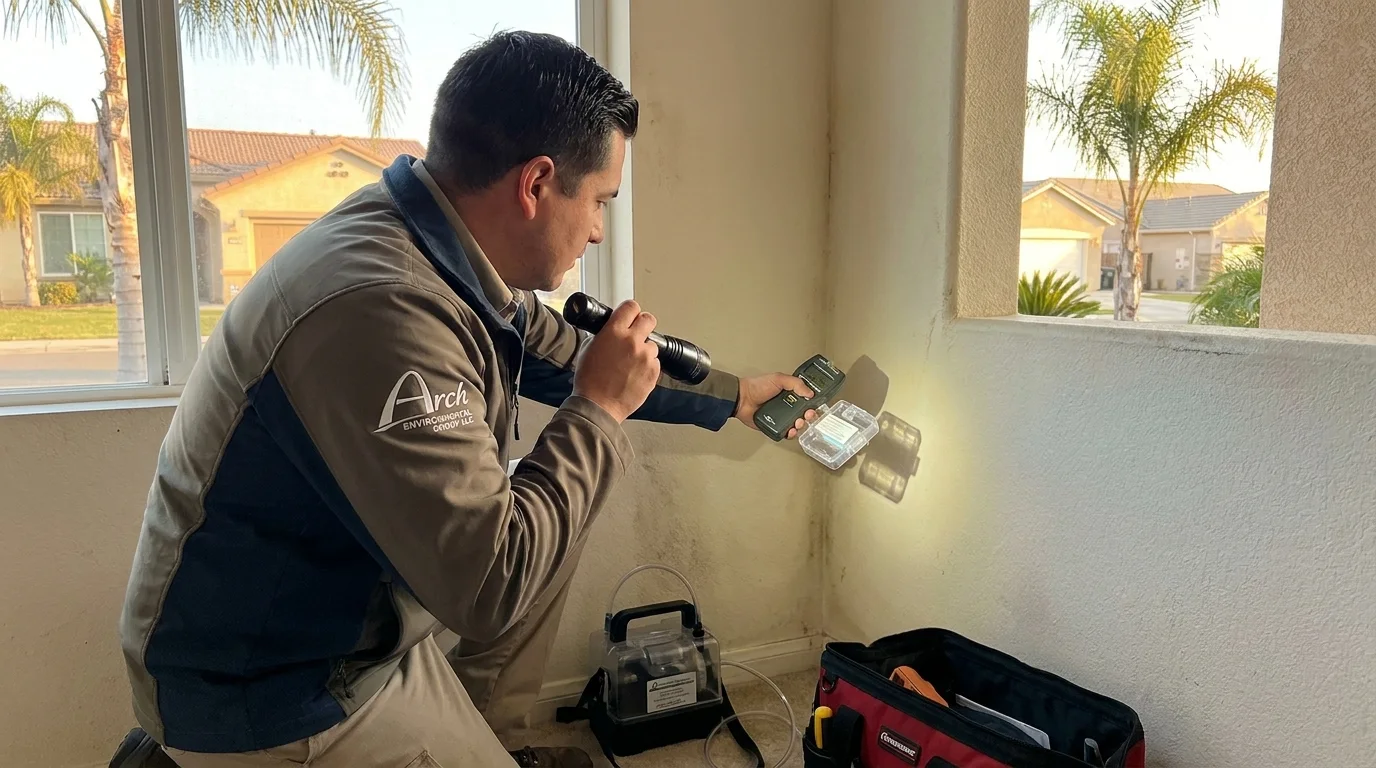
Mold Inspection and Testing in Kingsburg
Mold inspection and testing in Kingsburg and surrounding areas. Insurance billing accepted. Call (559) 296-2088.
You notice a musty smell in the hallway but the walls look fine. Or you see a small dark patch near the baseboard and wonder whether it’s dirt, mildew, or something that’s been quietly spreading inside the drywall for weeks. Mold inspection and testing exists precisely for that uncertainty, it replaces guesswork with documented evidence: what species are present, at what concentrations, and whether the air your family is breathing inside the home is measurably different from the air outside.
What mold inspection and testing actually involves
A mold inspection is not a quick walk-through with a flashlight. A thorough assessment starts with a visual survey of the entire structure, attic, crawlspace, mechanical rooms, and any area that has experienced water intrusion, condensation, or elevated humidity. Inspectors look for visible growth, staining, efflorescence, and building materials that have cupped, buckled, or delaminated in ways consistent with prolonged moisture exposure.
Air sampling is the diagnostic core of the service. A calibrated pump draws a measured volume of air through a spore trap cassette, which is then sent to an accredited third-party laboratory. The lab report identifies mold genera and quantifies spore counts in spores per cubic meter. Outdoor baseline samples are collected at the same time, without that control reading, an indoor count means very little. Surface sampling (tape lifts or swabs) is added when visible growth needs to be identified before a remediation contractor scopes the work.
Equipment used on a professional inspection typically includes a thermal infrared camera to locate moisture behind finished surfaces, a pin-type and pinless moisture meter to confirm readings, and a hygrometer to document relative humidity throughout the structure. In the San Joaquin Valley, where summer interior humidity can spike sharply when irrigation-season air moves through older window seals, those baseline humidity readings matter.
Laboratory turnaround is typically two to five business days for standard analysis; rush processing is available when a real estate transaction or a tenant dispute has a hard deadline.
Our process
-
Pre-inspection intake and records review. Before arriving on site, we gather the property’s water-loss history, any previous inspection reports, and the client’s specific concerns. Knowing that a roof was repaired eighteen months ago, for example, shapes where we spend the most time.
-
Systematic visual survey and moisture mapping. We move through the structure methodically, not just the rooms with visible symptoms. Mold colonies frequently originate in a mechanical closet or a poorly vented bathroom and migrate through wall cavities to appear somewhere unexpected. Thermal imaging and moisture meters document conditions in writing, not just memory.
-
Air and surface sampling. Spore trap cassettes are placed in areas of concern and in at least one unaffected interior zone. An outdoor sample is always collected as the environmental baseline. If visible growth is present, a tape lift or bulk sample is collected and packaged for the same laboratory submission.
-
Chain-of-custody submission to an accredited lab. Samples are logged, sealed, and submitted under a documented chain of custody to an accredited laboratory. As a NIOSH 582 Microscopist, Arch Environmental Group has the training to read and interpret raw spore data, not just receive a PDF summary.
-
Written report with findings and recommendations. You receive a written report that includes the lab results, annotated photographs, moisture readings, and a plain-language interpretation of what the data means for your property. If remediation is warranted, the report gives a remediation contractor the information they need to scope the work correctly.
What separates a good mold assessment from a bad one
The most common failure in mold inspection is inadequate sampling design. Placing a single air sample in the most visibly affected room and calling it done can miss the actual source, and it produces a report that won’t hold up to scrutiny from an insurance adjuster or a real estate attorney. A defensible assessment samples multiple zones, always includes an outdoor control, and documents the volume of air pulled through each cassette.
A second frequent problem is skipping thermal imaging. Surface mold is the symptom; moisture behind the surface is the cause. Without infrared imaging and moisture meter confirmation, an inspector can clear a wall that is actively feeding a colony on the other side of the drywall.
Insurance adjusters and industrial hygienists reviewing a claim look for: calibrated equipment records, accredited laboratory reports (not in-house test kits), chain-of-custody documentation, and a clear methodology statement. Reports built on instant-read consumer test kits are routinely rejected. The distinction between a certified industrial hygienist or microscopist-level assessment and a general contractor’s visual walk-through is significant when a claim or a legal dispute is on the table.
What does mold inspection and testing cost?
Typical costs for mold inspection and testing vary based on property size, the number of samples collected, and whether specialized services like thermal imaging or litigation-grade reporting are required. Most homeowners pay somewhere in the ranges below, these are industry-typical figures, not quotes from Arch Environmental Group.
| Scenario | Typical industry range |
|---|---|
| Single-room visual inspection + 2 air samples | $300 – $600 |
| Whole-house inspection + 4–6 air samples | $500 – $900 |
| Crawlspace or attic add-on sampling | $150 – $300 additional |
| Surface / tape-lift samples (per sample) | $50 – $150 additional |
| Rush laboratory processing | $75 – $200 additional |
| Post-remediation clearance testing | $300 – $600 |
Every property is different, and Arch Environmental Group provides a written scope before any work begins. Standard homeowners insurance policies often exclude mold inspection costs unless the mold is directly tied to a covered sudden water loss, your adjuster can confirm what your specific policy covers.
Seasonal and regional considerations
The San Joaquin Valley’s dry summers can be misleading. Irrigation runoff, aging slab foundations, and evaporative coolers that cycle moist air through ductwork all create localized humidity conditions that support mold growth even when outdoor humidity is low. The transition months, late fall when the first rains arrive and early spring when nighttime temperatures are still cool, are when condensation inside wall assemblies is most likely to go unnoticed until a colony is well established. Citrus-belt communities like Kingsburg, Selma, and Reedley also have a significant share of mid-century housing stock with original plaster and lath construction, which holds moisture differently than modern drywall and can sustain growth longer before showing visible signs.
Service area
Arch Environmental Group is based in Kingsburg and provides mold inspection and testing throughout the surrounding San Joaquin Valley, including Selma, Fresno, Hanford, Visalia, Tulare, and Reedley. City-specific service pages are linked from the main service area index.
If you’re seeing signs of mold, or just smelling something that shouldn’t be there, the right next step is documented air quality data, not a guess. Call (559) 296-2088 to schedule an indoor air quality test and get a written report you can actually use.
Services We Handle
- Mold Inspection
- Mold Testing
Frequently Asked Questions
What's the difference between a mold inspection and mold testing, do I need both?
Does homeowners insurance cover mold inspection and testing?
How do I know if the mold spore levels in my home are actually a problem?
Can I run the HVAC system while waiting for my mold inspection appointment?
What is post-remediation clearance testing, and is it the same as the initial inspection?
Looking for the best mold inspection and testing company in Kingsburg?
Arch Environmental Group LLC provides mold inspection and testing in Kingsburg, CA and the surrounding area, and has served local property owners since 2026. Customers rate us 5.0 out of 5 stars across 34 Google reviews. Call (559) 296-2088 to schedule mold inspection and testing or request a free estimate.
Schedule Mold Inspection and Testing
Independent, lab-verified testing across Kingsburg and California's Central Valley.
Related Coverage
- Our Environmental Testing Services
- Contact Arch Environmental Group LLC
- Mold Inspection and Testing in Clovis
- Mold Inspection and Testing in Dinuba
- Mold Inspection and Testing in Fowler
- Mold Inspection and Testing in Fresno
- Mold Inspection and Testing in Reedley
- Mold Inspection and Testing in Sanger
- Mold Inspection and Testing in Selma
- Mold Inspection and Testing in Visalia
- Blog › How To Test For Mold