
Clearance Testing and Post-Remediation Verification in Kingsburg
Certified clearance testing and post-remediation verification in Kingsburg and surrounding areas. Independent inspections, accredited lab analysis, clear written reports. Call (559) 296-2088.
Remediation work is finished. The containment is down, the contractor has packed up, and the space looks clean. But looks are not a clearance standard, and without independent post-remediation verification, there is no way to know whether airborne spore counts have returned to acceptable levels, whether asbestos fiber concentrations meet Cal/OSHA clearance thresholds, or whether a remediator’s own sampling is free from conflict of interest. Clearance testing exists precisely because the party who did the work should never be the same party who declares it done.
What clearance testing and post-remediation verification actually involves
Post-remediation verification is a third-party inspection and sampling protocol conducted after a remediation contractor has completed their scope of work. The goal is a documented, defensible answer to one question: does this space meet the clearance criteria specified in the remediation plan, the applicable standard, or the regulatory requirement?
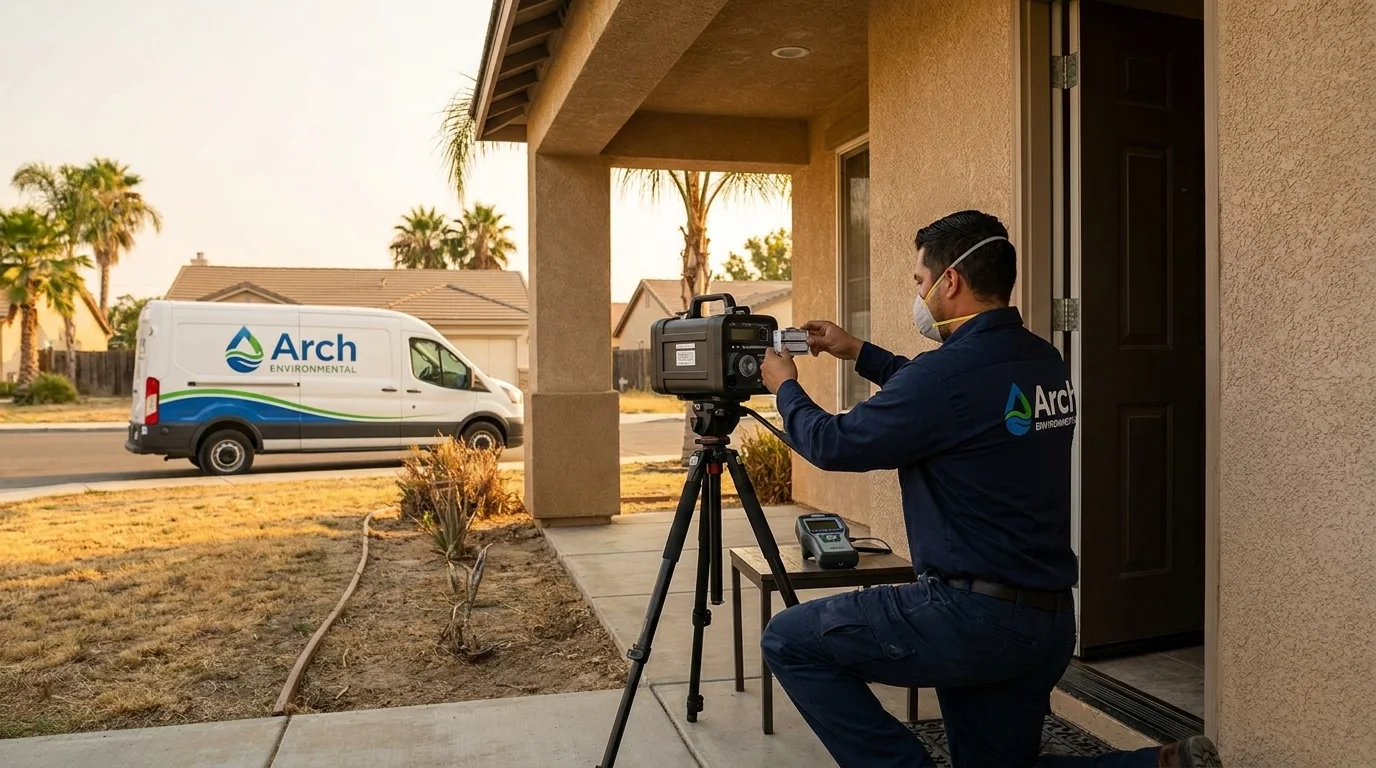
For mold clearance testing, that typically means air sampling inside the formerly affected area compared against outdoor control samples, evaluated against the IICRC S520 standard or the project’s written remediation protocol. Spore trap cassettes are collected using calibrated pumps at a defined flow rate and volume, then sent to an accredited laboratory. Results are interpreted in context, species composition matters as much as raw count, because certain genera (Stachybotrys, Chaetomium) are rarely found outdoors and carry more weight even at lower concentrations.
For asbestos clearance testing, the protocol is more tightly regulated. Phase contrast microscopy (PCM) or transmission electron microscopy (TEM) air sampling follows abatement of friable asbestos-containing materials, with fiber concentrations compared against the clearance level specified by Cal/OSHA or the project specification. As a Certified Asbestos Consultant with NIOSH 582 microscopist credentials, Arch Environmental Group LLC performs the analysis with the technical background to interpret fiber morphology, not just report a number.
A clearance inspection also includes a visual assessment before any air sampling begins. Sampling a space that still has visible debris or residue is a waste of everyone’s time and money; the visual walk-through is the gate that determines whether the project is ready for final air testing at all.
The deliverable is a written clearance letter or post-remediation verification report, the document your insurance carrier, property manager, lender, or future buyer will ask for.
Our process
-
Pre-sampling visual inspection. Before any equipment is set up, the affected area is walked to confirm that physical remediation is complete: no visible mold growth, no remaining asbestos debris, containment barriers intact or properly removed, HEPA filtration equipment off (for mold, running equipment during sampling artificially suppresses counts).
-
Sampling plan and control placement. Outdoor or unaffected-area control samples are collected first to establish a baseline. Sample locations inside the remediated space are selected based on the size of the area, the nature of the original contamination, and the applicable standard, not placed arbitrarily.
-
Calibrated air sampling. Spore trap cassettes or fiber filters are run at documented flow rates and volumes using calibrated pumps. Chain of custody is maintained from collection through laboratory submission.
-
Accredited laboratory analysis. Samples are submitted to an accredited third-party laboratory. For mold, results identify genus and concentration. For asbestos PCM/TEM, fiber counts are compared directly to the clearance threshold.
-
Written clearance report or failure documentation. If the space passes, you receive a signed clearance letter with supporting laboratory data, the document that closes out the remediation file. If the space does not pass, the report identifies where concentrations remain elevated so the remediator can address the deficiency before re-testing.
What separates a good clearance response from a bad one
The most common failure in post-remediation verification is not technical, it is structural. When the same contractor who performed the remediation also collects the clearance samples, the result is not independent verification; it is self-certification. Regulatory bodies and insurance carriers increasingly scrutinize this arrangement, and for good reason: there is no financial incentive for a remediator to fail their own work.
On the technical side, common problems include sampling too soon after remediation (disturbed dust has not settled), running HEPA air scrubbers during mold sampling (which suppresses counts and produces a falsely clean result), placing all samples in the center of a room rather than near original contamination zones, and submitting samples to non-accredited laboratories.
For asbestos clearance specifically, the analytical method matters. PCM is the standard for most abatement projects, but PCM cannot distinguish asbestos fibers from other elongated mineral particles. When the fiber count is near the clearance threshold, or when the abated material contained amphibole asbestos, TEM analysis provides a more defensible result. A Certified Asbestos Consultant understands when to escalate the method.
Insurance adjusters and industrial hygienists reviewing remediation files look for three things: an independent sampler, an accredited laboratory, and a written report that references the applicable standard. A clearance letter that lacks any of these elements may not close the claim.
What does clearance testing and post-remediation verification cost?
Typical costs depend on the contaminant type, the number of samples required, and whether the project involves a single room or an entire structure. The table below reflects industry-typical ranges, every project is different, and Arch Environmental Group LLC provides a written scope before any work begins.
| Scenario | Typical industry range |
|---|---|
| Single-room mold clearance air testing (2–3 samples) | $300 – $600 |
| Whole-home mold clearance (5–8 samples, lab included) | $600 – $1,200 |
| Asbestos abatement clearance, PCM (single work area) | $400 – $800 |
| Asbestos clearance with TEM analysis | $700 – $1,500 |
| Multi-area or commercial post-remediation verification | $1,000 – $3,000+ |
Homeowners insurance coverage for clearance testing varies by policy and carrier. Many policies that cover mold remediation also cover the cost of third-party clearance testing as part of the remediation scope, particularly when the testing is required to close the claim. Documenting the need for independent verification early in the claim process improves the likelihood of reimbursement.
Seasonal and regional considerations
In California’s San Joaquin Valley, the combination of hot, dry summers and wet, foggy winters creates two distinct windows when post-remediation verification is most critical. Winter moisture intrusion, from roof leaks, failing stucco, or inadequate drainage against clay-heavy soils, drives mold colonization in wall cavities that may not be discovered until spring. Summer heat accelerates drying at the surface while deeper structural materials stay damp, which can produce a false sense that remediation is complete before spore counts have normalized. Clearance sampling timed correctly to the drying cycle, rather than to the contractor’s schedule, produces more reliable results in this climate.
For asbestos, the Valley’s large stock of mid-century residential and agricultural construction means abatement projects are common, and clearance testing demand follows accordingly.
Service area
Arch Environmental Group LLC is based in Kingsburg and provides clearance testing and post-remediation verification throughout the surrounding San Joaquin Valley communities, including Fresno, Visalia, Hanford, Tulare, Selma, Reedley, and Clovis. City-specific service pages link back here for full process detail.
If remediation is finished and you need an independent clearance letter, for your insurance carrier, your property manager, or your own peace of mind, call Arch Environmental Group LLC at (559) 296-2088 to schedule your post-remediation verification sampling.
Frequently Asked Questions
Does homeowners insurance cover clearance testing and post-remediation verification?
Why does the clearance sampler need to be independent from the remediation contractor?
What happens if the space fails clearance testing?
For mold clearance, does the HEPA air scrubber need to be off during sampling?
What is the difference between PCM and TEM for asbestos clearance air testing, and when does it matter?
Looking for the best clearance testing and post-remediation verification company in Kingsburg?
Arch Enviornmental Group LLC provides clearance testing and post-remediation verification in Kingsburg, CA and the surrounding area, and has served local property owners since 2026. Customers rate us 5.0 out of 5 stars across 34 Google reviews. Call (559) 296-2088 to schedule clearance testing and post-remediation verification or request a free estimate.
Schedule Clearance Testing and Post-Remediation Verification
Independent, lab-verified testing across Kingsburg and California's Central Valley.
Related Coverage
- Our Environmental Testing Services
- Contact Arch Enviornmental Group LLC
- Clearance Testing and Post-Remediation Verification in Clovis
- Clearance Testing and Post-Remediation Verification in Dinuba
- Clearance Testing and Post-Remediation Verification in Fowler
- Clearance Testing and Post-Remediation Verification in Fresno
- Clearance Testing and Post-Remediation Verification in Reedley
- Clearance Testing and Post-Remediation Verification in Sanger
- Clearance Testing and Post-Remediation Verification in Selma
- Clearance Testing and Post-Remediation Verification in Visalia
- Why Your Mold Tester Should Never Be Your Mold Remover