
Indoor Air Quality Testing in Kingsburg
Certified indoor air quality testing in Kingsburg and surrounding areas. Independent inspections, accredited lab analysis, clear written reports. Call (559) 296-2088.
You’ve changed the HVAC filter, opened the windows, and still can’t shake the headache that hits every afternoon around 2 p.m. Or maybe someone in the house has developed a persistent cough that no doctor can fully explain. Indoor air quality problems are invisible by definition, you can’t see volatile organic compounds off-gassing from new flooring, and you can’t smell carbon dioxide building up in a poorly ventilated room. An air quality inspection puts numbers on what your senses can’t detect, so you know exactly what you’re dealing with and what to do next.
What indoor air quality testing actually involves
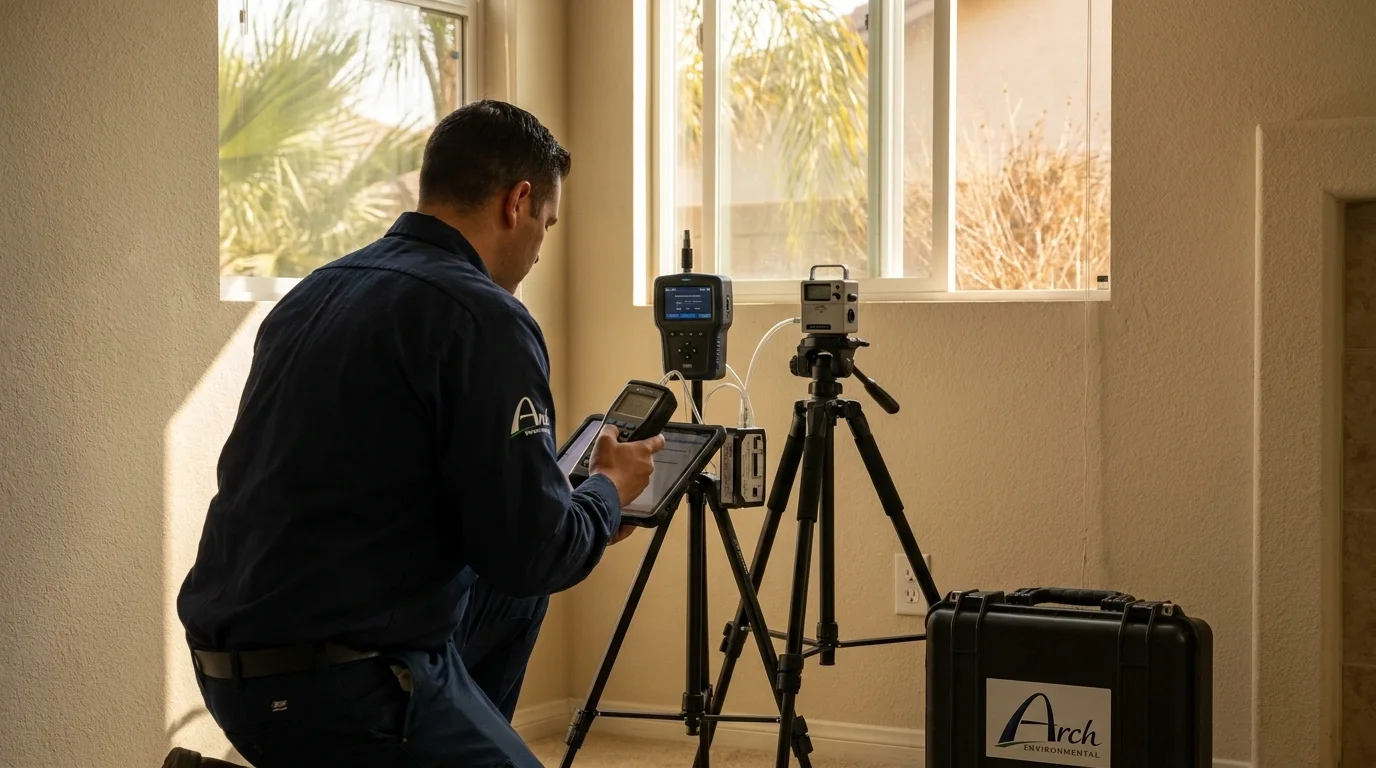
An IAQ assessment is not a single swab or a consumer-grade monitor from a hardware store. A thorough inspection samples for multiple contaminant categories simultaneously, because indoor air problems rarely have a single source. Depending on the building’s history and the symptoms being reported, testing may cover airborne particulates (PM2.5 and PM10), mold spores and fungal fragments, volatile organic compounds (VOCs) from adhesives, paints, and cleaning products, carbon monoxide and carbon dioxide, formaldehyde, radon, and, in older Central Valley construction, asbestos fibers disturbed by renovation or deterioration.
Arch Environmental Group holds certifications as a Certified Asbestos Consultant and Lead Inspector/Assessor, with a NIOSH 582 Microscopist credential for fiber identification. That matters here: fiber analysis requires laboratory microscopy, not just a field meter, and the credential determines whether the results hold up in a disclosure, a remediation scope, or a legal proceeding.
Sampling methods vary by contaminant. Airborne mold spores are captured on spore-trap cassettes or cultured on impaction media and sent to an accredited laboratory. VOCs require Summa canisters or sorbent tubes analyzed by gas chromatography. Asbestos fiber counts use phase-contrast or transmission electron microscopy. A credible inspection documents the chain of custody for every sample so results are defensible.
Most residential inspections take two to four hours on-site. Laboratory turnaround typically runs three to five business days for standard analysis, with rush options available.
Our process
-
Pre-inspection intake and building history review. Before sampling begins, the inspector reviews the structure’s age, any recent renovations, HVAC system type, prior water intrusion events, and the specific symptoms occupants are reporting. This shapes which contaminants get prioritized and where samples are placed.
-
Baseline and ambient sampling. Outdoor control samples are collected alongside indoor samples. Without a baseline, there is no way to distinguish elevated indoor concentrations from regional background levels, a step that less rigorous inspectors routinely skip.
-
Systematic interior sampling across zones. Samples are placed in occupied areas, near suspected source materials, in HVAC supply and return paths, and in any spaces with visible staining, odor, or reported symptoms. Each sample is logged with location, time, temperature, and relative humidity.
-
Laboratory analysis and chain-of-custody documentation. Samples are shipped to an accredited third-party laboratory under documented chain of custody. Results are interpreted against EPA, OSHA, ACGIH, and California OEHHA reference values as applicable to the contaminants tested.
-
Written report with findings and recommendations. You receive a plain-language report that states what was found, at what concentration, what the relevant health-based guideline is, and, where levels are elevated, what remediation or engineering controls are appropriate. The report is formatted to support insurance claims, real estate transactions, or contractor scopes of work.
What separates a good air quality inspection from a bad one
The most common failure in IAQ testing is sampling for only one contaminant when the building has multiple potential sources. A mold-only test misses the VOCs from the spray foam installed during the same renovation. A radon test alone does not explain why second-floor occupants are symptomatic while the basement reads clean.
A second common problem is the absence of outdoor controls. Indoor mold spore counts mean almost nothing without a simultaneous outdoor sample taken under similar conditions. Reporting a raw indoor number without context is how an inspector can alarm a homeowner about concentrations that are actually normal for the season and region.
For asbestos specifically, the credential matters more than the equipment. California requires that bulk asbestos sampling and air clearance testing for friable materials be performed or directly supervised by a Certified Asbestos Consultant. An inspector without that credential cannot legally issue a clearance letter, which means any abatement work that follows cannot be properly closed out.
Finally, a good report tells you what to do next. A list of numbers without interpretation, or a report that simply says “consult a professional,” is not a finished work product.
What does indoor air quality testing cost?
Typical costs for residential and light-commercial IAQ testing depend heavily on the number of contaminants sampled, the number of rooms, and whether laboratory rush fees apply. The figures below reflect typical industry ranges, every property is different, and Arch Environmental Group provides a written scope before any work begins so you know exactly what is included. Homeowners insurance may cover IAQ testing when it is ordered as part of a documented loss event (water damage, fire, or a covered mold claim); standalone “wellness” testing is generally not covered, though it is worth confirming with your carrier.
| Scenario | Typical industry range |
|---|---|
| Single-contaminant screen (radon or CO), one zone | $150 – $350 |
| Mold spore sampling, 3–5 rooms with outdoor control | $400 – $800 |
| Full residential IAQ panel (mold, VOCs, particulates, CO/CO₂) | $800 – $1,800 |
| Asbestos bulk sampling, pre-renovation (per sample, lab included) | $25 – $75 per sample |
| Post-remediation air clearance testing (mold or asbestos) | $500 – $1,200 |
| Commercial or multi-unit building assessment | $1,500 – $5,000+ |
Seasonal and regional considerations
The San Joaquin Valley’s climate creates a specific IAQ calendar worth knowing. Tule fog season, roughly November through February, drives relative humidity indoors as residents seal up homes and reduce ventilation. Condensation on single-pane windows, common in Kingsburg’s older housing stock, can feed mold growth on window frames and adjacent drywall within days of a sustained moisture event.
Summer brings the opposite problem: agricultural dust, wildfire smoke particulates, and ozone push outdoor PM2.5 into homes through gaps in weatherstripping and poorly filtered HVAC systems. If your household runs the air conditioner continuously from June through September, the filter and duct system become the primary line of defense, and a compromised one if maintenance has lapsed.
Homes built before 1980 in Fresno County and the surrounding communities frequently contain asbestos in floor tile, pipe insulation, popcorn ceilings, and duct tape. Any renovation that disturbs those materials without prior bulk sampling creates a fiber release that a standard air quality monitor will not detect.
Service area
Arch Environmental Group is based in Kingsburg and serves property owners throughout the surrounding Central Valley, including Fresno, Selma, Hanford, Visalia, Tulare, Reedley, and Clovis. The city-specific pages for each area link back here for the full technical detail on what the inspection involves.
If the air inside your home or building isn’t adding up, recurring symptoms, a smell that won’t clear, a recent renovation or water event, call (559) 296-2088 to schedule your indoor air quality assessment. You’ll get a written report with findings and next steps, not just a number on a screen.
Frequently Asked Questions
What contaminants does a standard indoor air quality test actually measure?
Does homeowners insurance cover indoor air quality testing?
Why does an IAQ test require an outdoor control sample, and what happens if one isn't taken?
What is a NIOSH 582 Microscopist, and why does that credential matter for asbestos fiber testing?
How long does it take to get results after an air quality inspection?
Looking for the best indoor air quality testing company in Kingsburg?
Arch Enviornmental Group LLC provides indoor air quality testing in Kingsburg, CA and the surrounding area, and has served local property owners since 2026. Customers rate us 5.0 out of 5 stars across 34 Google reviews. Call (559) 296-2088 to schedule indoor air quality testing or request a free estimate.
Schedule Indoor Air Quality Testing
Independent, lab-verified testing across Kingsburg and California's Central Valley.
Related Coverage
- Our Environmental Testing Services
- Contact Arch Enviornmental Group LLC
- Indoor Air Quality Testing in Clovis
- Indoor Air Quality Testing in Dinuba
- Indoor Air Quality Testing in Fowler
- Indoor Air Quality Testing in Fresno
- Indoor Air Quality Testing in Reedley
- Indoor Air Quality Testing in Sanger
- Indoor Air Quality Testing in Selma
- Indoor Air Quality Testing in Visalia
- 7 Signs of Bad Indoor Air Quality (and Which Tests Confirm Each One)