
Post-Flood Mold Assessment in Dinuba
Certified post-flood mold assessment in Dinuba, CA. Independent inspections with accredited lab analysis. Call (559) 296-2088.
Our crews are dispatched from our Kingsburg, CA headquarters and respond quickly to projects across Dinuba.
Dinuba sits in the heart of the San Joaquin Valley, where summer heat and periodic heavy rain events, including the kind of atmospheric river flooding that has repeatedly stressed Tulare County’s drainage infrastructure, create conditions where mold can begin colonizing wet building materials within 24 to 48 hours of a flood. If your home or commercial property in Dinuba has taken on water, a professional post-flood mold assessment is not a precaution you can safely defer: by the time visible growth appears, airborne spore counts are often already elevated.
Why Dinuba Properties Face Elevated Mold Risk After Flooding
The San Joaquin Valley’s clay-heavy soils drain slowly, and Dinuba’s relatively flat terrain means floodwater from heavy storms or irrigation-related overflows doesn’t always move away from foundations quickly. Water that pools against a slab or seeps into a crawl space creates sustained moisture conditions that standard ventilation cannot resolve on its own.
Dinuba’s housing stock includes a significant number of homes built during the mid-twentieth century agricultural boom, when construction methods relied on wood-framed walls with minimal vapor barriers. Those older wall assemblies absorb and hold moisture deep in the framing long after surface materials feel dry to the touch. A moisture meter reading taken at drywall surface level can show normal values while the underlying studs and bottom plates remain saturated, exactly the conditions that allow mold to establish before anyone realizes there is a problem.
Farm-adjacent properties on the edges of Dinuba also contend with irrigation runoff and high ambient humidity during certain growing seasons, which compounds the baseline moisture load on structures that have already experienced flood intrusion.
Our Post-Flood Mold Assessment Process in Dinuba
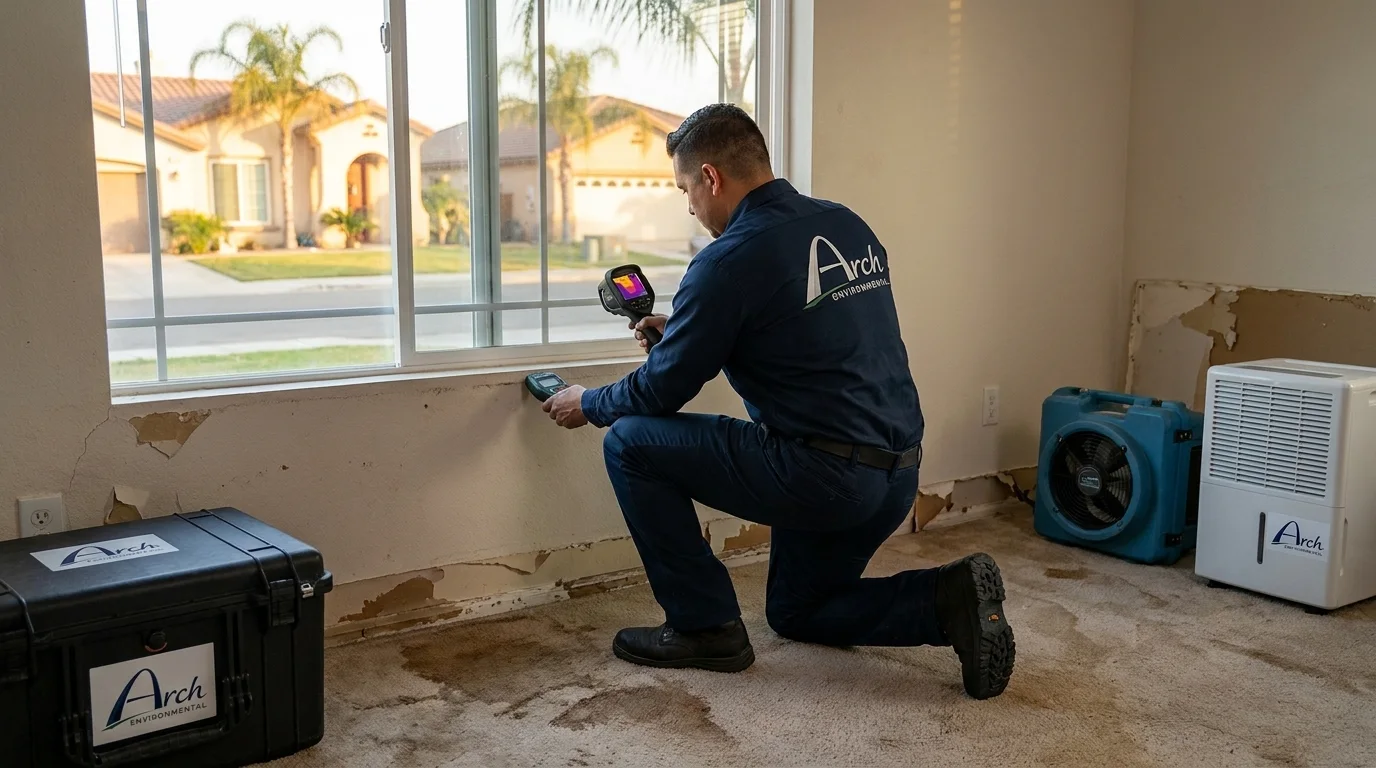
A thorough assessment starts with moisture mapping, using calibrated pin and pinless meters alongside thermal imaging to locate water that has migrated behind walls, under flooring, or into ceiling cavities. Surface appearance is not a reliable guide. Water follows framing channels and vapor barriers in ways that are rarely obvious from a visual inspection alone.
Once moisture boundaries are established, air sampling is conducted in affected areas and compared against an outdoor baseline collected at the same time. This comparison is what separates a meaningful air quality result from a number without context: spore types and concentrations that appear inside but not outside indicate active amplification within the building envelope.
Surface sampling, tape lifts or swabs from suspect materials, is added when visual evidence of growth is present or when the moisture map identifies areas that have been wet long enough for colonization to be likely. All samples are analyzed by an accredited laboratory, and results are compiled into a written report that documents findings, identifies affected zones, and provides scope guidance for any remediation that follows.
Arch Environmental Group holds certifications as a Certified Asbestos Consultant and Lead Inspector/Assessor, and our microscopists carry NIOSH 582 credentials, which means that when sampling turns up unexpected materials in older Dinuba homes, we are equipped to address those findings within the same assessment rather than requiring a separate mobilization.
Reaching Dinuba from Kingsburg
Arch Environmental Group is based in Kingsburg, roughly 20 miles northwest of Dinuba via Highway 99 and State Route 201. Scheduling is handled by phone at (559) 296-2088. Because we work by appointment rather than dispatching emergency crews, we encourage property owners to call as early as possible after a flood event, prompt scheduling matters when the 24-to-48-hour mold colonization window is already running.
Dinuba Insurance Coordination
Most homeowner policies that include flood or water damage coverage require documentation of the loss scope before remediation begins. A written mold assessment report, with moisture maps, laboratory results, and photographic documentation, gives your adjuster the evidence needed to evaluate the claim accurately. We provide reports in formats that align with standard carrier requirements, and we can speak directly with adjusters when clarification is needed.
Local Note
Dinuba’s older residential blocks include homes with original plaster-and-lath interior walls rather than modern drywall. Plaster is denser and absorbs water more slowly than gypsum board, which can create a false sense of security in the days after a flood, the wall surface may feel firm and look intact while the lath and framing behind it hold significant moisture. In these homes, we extend moisture mapping to include probe readings through outlet boxes and any accessible wall cavities, because surface-only readings routinely underestimate the true wet zone in plaster construction.
If your Dinuba home has taken on floodwater and you are uncertain whether the structure has fully dried, the right call is an assessment before remediation, not after. Call Arch Environmental Group at (559) 296-2088 to schedule a post-flood mold assessment and get a clear picture of what is actually happening inside your walls.
Serving Dinuba from our Kingsburg headquarters — ★ 5.0 · 34 Google reviews
“Arch and Environmental were efficient and professional with their work. Results were amazing highly recommend.” — Natalie, September 2026Read our reviews on Google →
Post-Flood Mold Assessment in Dinuba: Service Coverage
Frequently Asked Questions
How soon after flooding should Dinuba homeowners schedule a mold assessment?
Does Dinuba's clay soil and flat terrain affect how mold assessments are conducted?
Are older Dinuba homes with plaster walls harder to assess for mold after a flood?
What does a post-flood mold assessment report include, and will it satisfy my insurance adjuster in Dinuba?
What is the difference between air sampling and surface sampling in a post-flood mold inspection?
Post-Flood Mold Assessment in Dinuba
Our crews are based in Kingsburg, CA and take on projects across Dinuba. Call for a free estimate.