
Post-Flood Mold Assessment in Sanger
Certified post-flood mold assessment in Sanger, CA. Independent inspections with accredited lab analysis. Call (559) 296-2088.
Our crews are dispatched from our Kingsburg, CA headquarters and respond quickly to projects across Sanger.
Sanger sits in the heart of the San Joaquin Valley, where summer heat regularly pushes past 100°F and the Kings River basin can deliver flash flooding that saturates crawl spaces and wall cavities faster than most homeowners expect. When floodwater retreats, it leaves behind moisture that the Valley’s humidity keeps locked inside building materials, and mold can begin colonizing damp framing and insulation within 24 to 48 hours of initial saturation. A post-flood mold assessment is the step that tells you whether that colonization has started, how far it has spread, and what documentation your insurance carrier will need before remediation begins.
Why Sanger Properties Are Particularly Vulnerable After a Flood
The agricultural landscape surrounding Sanger shapes flood risk in ways that aren’t always obvious. Irrigation canals and drainage laterals that crisscross Fresno County can back up during heavy rain events, pushing water toward residential foundations rather than away from them. Many homes in the Sanger area were built in the mid-20th century on slab foundations with minimal vapor barriers, a construction standard that made sense for dry-season living but leaves little defense when standing water enters from below or through block-wall weep holes.
Older stucco exteriors common to this part of the Central Valley can trap moisture behind the finish coat for weeks after a flood event, reading dry at the surface while the wood sheathing beneath stays wet. That hidden saturation is exactly where mold establishes itself before it becomes visible. A surface inspection alone will miss it; calibrated moisture mapping and air sampling are required to find it.
Our Post-Flood Mold Assessment Process in Sanger
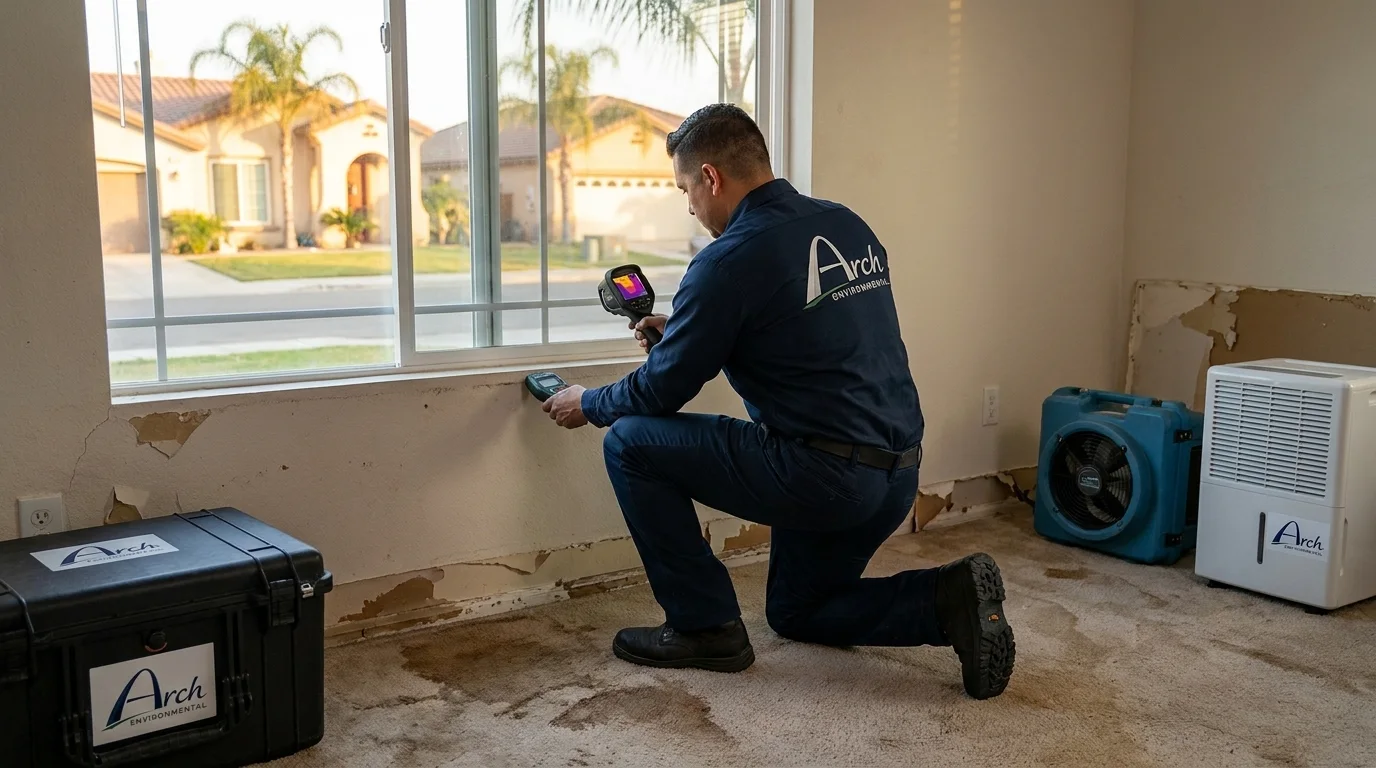
Every assessment begins with a systematic moisture mapping survey using thermal imaging and calibrated moisture meters across all affected rooms, wall cavities, and subfloor areas. Elevated readings guide where we collect air samples and surface samples, we don’t sample randomly, because random sampling misses the pockets where mold is actually active.
Air samples are collected using calibrated spore-trap cassettes and analyzed by an accredited laboratory. The results tell us the species present, the spore concentration indoors versus a control sample taken outside, and whether concentrations indicate active amplification rather than background levels. For Sanger properties where the flood source was an irrigation lateral or agricultural drainage channel, we also flag the sample results for any species associated with soil-borne or agricultural environments, which can differ from typical indoor mold profiles.
All findings are compiled into a written assessment report formatted to meet insurance documentation requirements, specific affected areas, moisture readings by location, sample chain-of-custody records, and laboratory results. If remediation is warranted, the report includes a scope of work that a licensed remediation contractor can bid against.
Equipment and Methods We Use for Post-Flood Assessment
Thermal imaging cameras detect temperature differentials that reveal evaporative cooling in wet building materials, a reliable indicator of moisture that hasn’t yet dried. Paired with pin and pinless moisture meters, thermal imaging lets us map the full extent of saturation without unnecessary destructive investigation.
For air quality testing, we use calibrated pumps drawing a precise volume of air through spore-trap media. Sample integrity depends on consistent flow rate and documented collection time, details that matter when a laboratory report is going to an insurance adjuster or a remediation contractor. As a certified asbestos consultant and lead inspector assessor with NIOSH 582 microscopist credentials, Arch Environmental Group brings laboratory-grade analytical discipline to every field sample collected.
Local Note
Sanger’s older housing stock, particularly homes built between the 1950s and 1970s, frequently used rock lath and plaster rather than drywall. Plaster walls absorb floodwater slowly but release it even more slowly, which means a wall that feels firm to the touch three days after a flood can still carry moisture readings well above the threshold for mold growth. When we assess plaster-wall construction in this area, we extend our moisture mapping timeline and take readings at multiple depths rather than relying on surface-contact meters alone. Skipping that step is one of the most common reasons a mold problem goes undetected until it’s visible, and by then, the remediation scope is significantly larger.
If your property flooded and you’re not sure whether the walls have dried adequately, that uncertainty is itself a reason to schedule an assessment. Arch Environmental Group serves Sanger from our Kingsburg office, a short drive east on Kings Canyon Road, and can schedule prompt appointments for properties throughout the area. Call (559) 296-2088 to discuss your situation and arrange an on-site evaluation.
Serving Sanger from our Kingsburg headquarters — ★ 5.0 · 34 Google reviews
“Very impressed with Arch Environmental's professionalism. I called during the week, forget which day, but they had somebody out here in Bakersfield the following day to do the testing. Overall I'm satisfied. It didn't take much effort from my part. 5/5” — J, September 2026Read our reviews on Google →
Post-Flood Mold Assessment in Sanger: Service Coverage
Frequently Asked Questions
How quickly can Arch Environmental Group reach Sanger from the Kingsburg office for a post-flood mold assessment?
Sanger's irrigation canals flooded my crawl space, does that change what you test for in the mold assessment?
My Sanger home has original plaster walls from the 1960s, does that affect how the mold assessment is done?
What does the post-flood mold assessment report include, and will it satisfy my insurance carrier?
How long after a flood should I wait before scheduling a mold assessment in Sanger?
Post-Flood Mold Assessment in Sanger
Our crews are based in Kingsburg, CA and take on projects across Sanger. Call for a free estimate.