
Radon Testing in Squaw Valley
Certified radon testing in Squaw Valley, CA. Independent inspections with accredited lab analysis. Call (559) 296-2088.
Our crews are dispatched from our Kingsburg, CA headquarters and respond quickly to projects across Squaw Valley.
Squaw Valley sits in the Sierra Nevada foothills at elevations where granite bedrock and decomposed granitic soils are the norm, and that geology matters when it comes to radon. Uranium-bearing granite releases radon gas as it decays, and homes built directly over or into this kind of terrain can accumulate radon in crawl spaces, basements, and slab-on-grade foundations at levels that deserve serious attention. If you are buying, selling, or simply living in a home in this part of Fresno County, a professional radon test is one of the most straightforward steps you can take to understand what the air in your home actually contains.
Why Squaw Valley Properties See Elevated Radon Risk
The Sierra Nevada foothills are geologically distinct from California’s Central Valley floor. The granitic and metamorphic rock formations common to this elevation band are naturally higher in uranium and radium than the sedimentary soils found further west. As those minerals decay, radon gas migrates upward through soil and rock fissures. Homes in Squaw Valley and the surrounding Fresno County foothill communities tend to sit closer to that source material, and many were built with crawl spaces or partial basements that give the gas a direct pathway into living areas.
Cooler nighttime temperatures at this elevation also create negative pressure inside homes as warm indoor air rises and escapes, drawing soil gases inward through foundation cracks, utility penetrations, and gaps around pipe sleeves. That stack effect is more pronounced in mountain and foothill homes than in valley construction, and it means radon concentrations can be meaningfully higher in winter months when windows stay closed and ventilation is reduced.
Our Radon Testing Process in Squaw Valley
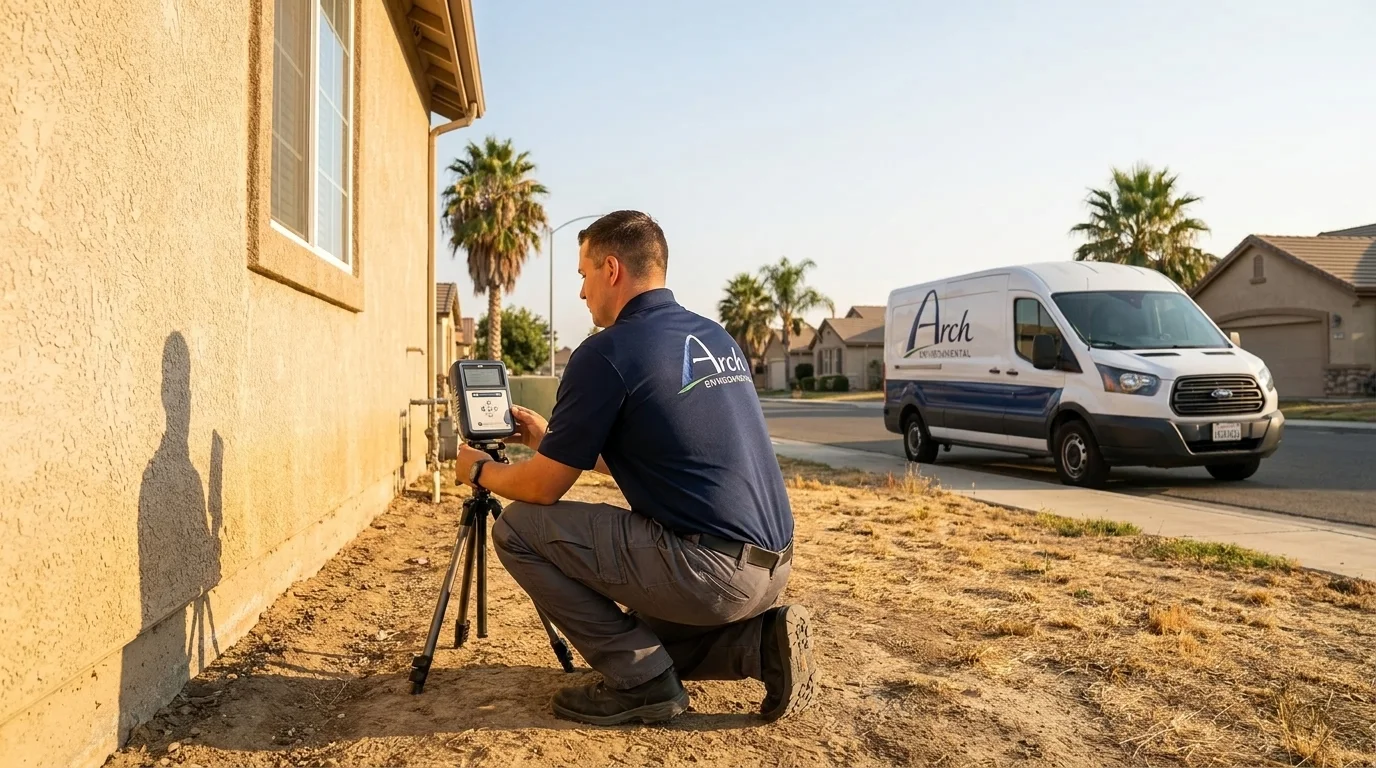
Arch Environmental Group uses calibrated continuous electronic radon monitors rather than passive charcoal canisters for most residential tests. Continuous monitors record radon levels hour by hour across the full testing period, which is typically a minimum of 48 hours for a short-term test conducted under closed-building conditions. That hourly data is useful in foothill homes because it can reveal the stack-effect pattern described above: radon levels that climb overnight and ease during the warmer afternoon hours. A single averaged number from a charcoal canister would obscure that pattern entirely.
Before placing monitors, we identify the lowest livable level of the home, since radon concentrates at its highest in the space closest to the soil. We also document foundation type, visible penetrations, and any existing sub-slab or crawl-space ventilation, because those details inform both the test placement and any mitigation recommendations that follow. The EPA action level is 4 picocuries per liter; we report results against that benchmark and explain what the numbers mean in plain language.
Reaching Squaw Valley from Kingsburg
Arch Environmental Group is based in Kingsburg, in the San Joaquin Valley. Squaw Valley is located in the foothill zone east of Fresno, and the most direct route follows Highway 180 east from the valley floor up into Fresno County’s mountain communities. Scheduling is handled by phone at (559) 296-2088, and we coordinate appointment windows that work for the property’s occupancy and the required closed-building conditions. If you are working toward a real estate transaction deadline, call early so we can align the testing window with your contingency timeline.
Local Note
Foothill homes in this part of Fresno County were often built in construction eras when sub-slab vapor barriers were not standard practice, and many crawl-space enclosures use bare soil rather than sealed liners. That combination, bare soil plus an unlined crawl space plus granitic subsoil, creates nearly ideal conditions for radon entry. If a home inspection report notes an unencapsulated crawl space, that detail alone is a reasonable prompt to prioritize radon testing before closing. Arch Environmental Group’s team holds certifications including Lead Inspector Assessor credentials, and we approach environmental testing in these homes with the same methodical documentation standard across all hazard types.
If your Squaw Valley home has been tested before, it is worth knowing that older passive test results may not capture the full picture. A continuous monitor test gives you time-resolved data that reflects how the home actually breathes across a full day-night cycle at this elevation.
Scheduling a radon test in Squaw Valley is a straightforward process, and the results give you concrete information rather than guesswork. Call Arch Environmental Group at (559) 296-2088 to discuss your property, your timeline, and which testing protocol fits your situation.
Serving Squaw Valley from our Kingsburg headquarters — ★ 5.0 · 34 Google reviews
“Very impressed with Arch Environmental's professionalism. I called during the week, forget which day, but they had somebody out here in Bakersfield the following day to do the testing. Overall I'm satisfied. It didn't take much effort from my part. 5/5” — J, September 2026Read our reviews on Google →
Radon Testing in Squaw Valley: Service Coverage
Frequently Asked Questions
Are homes in the Squaw Valley area at higher radon risk than properties in the Central Valley?
How does Squaw Valley's elevation and climate affect radon levels inside a home?
What does a radon inspection involve for a Squaw Valley property with a crawl space?
If I am buying a home in Squaw Valley, how should I time the radon test within my escrow period?
What is continuous radon monitoring and why does Arch Environmental Group use it instead of charcoal canisters?
Radon Testing in Squaw Valley
Our crews are based in Kingsburg, CA and take on projects across Squaw Valley. Call for a free estimate.