
Radon Testing in Bakersfield
Certified radon testing in Bakersfield, CA. Independent inspections with accredited lab analysis. Call (559) 296-2088.
Our crews are dispatched from our Kingsburg, CA headquarters and respond quickly to projects across Bakersfield.
Bakersfield sits in the southern San Joaquin Valley on a thick bed of alluvial sediment deposited over millennia by the Kern River, and that geology matters more than most homeowners realize. Uranium-bearing minerals naturally present in valley soils decay into radium, which in turn releases radon gas. That gas can migrate upward through soil and into living spaces year-round, but Bakersfield’s long dry summers and sealed, air-conditioned homes create conditions where indoor radon concentrations can quietly climb without any visible sign. Arch Environmental Group tests for radon in Bakersfield homes and commercial properties so you know exactly what you are breathing.
Why Bakersfield Properties Are Worth Testing
The San Joaquin Valley floor is underlain by sedimentary formations that vary in uranium content across Kern County. While California as a whole tends to have lower average radon readings than states in the EPA’s high-risk Zone 1, that statewide average obscures meaningful variation at the local level. Slab-on-grade construction, common throughout Bakersfield’s postwar and contemporary subdivisions, can still allow radon to enter through slab cracks, construction joints, and utility penetrations. Homes with raised foundations and crawl spaces present a different entry pathway: soil gas accumulates beneath the floor deck and diffuses upward.
Bakersfield’s climate adds a layer of complexity. During the region’s hot summers, residents keep windows closed and HVAC systems running continuously, reducing natural air exchange. Lower ventilation rates mean radon that enters has fewer pathways to escape, which can push indoor concentrations higher than the same home would show in a more naturally ventilated climate. Winter temperature inversions, a well-documented phenomenon in the valley, can also suppress outdoor air movement and affect how soil gases behave near the foundation.
Our Radon Testing Process in Bakersfield
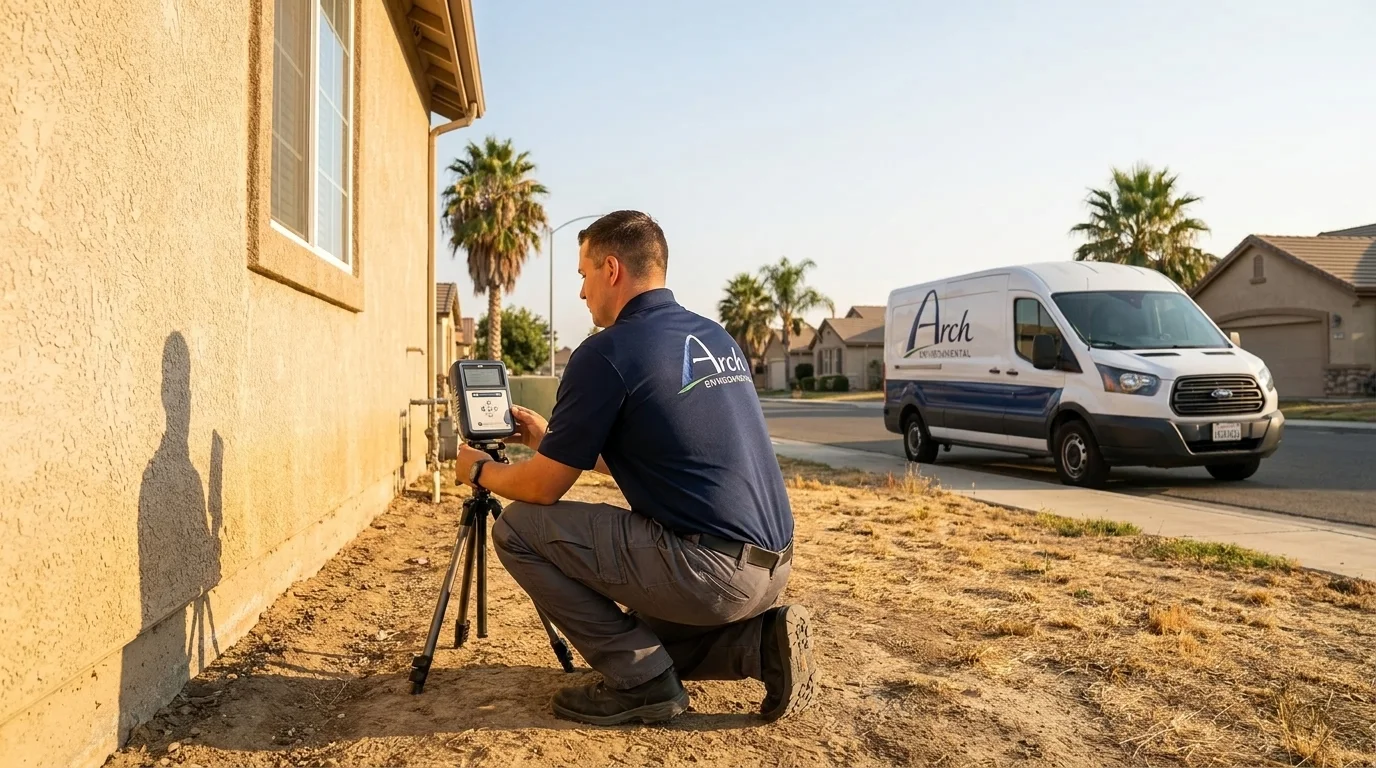
Arch Environmental Group uses continuous electronic radon monitors rather than passive charcoal canisters for most residential and commercial tests. Continuous monitors log radon concentrations hour by hour throughout the test period, which typically runs 48 hours under closed-building conditions as specified by EPA and state guidance. That hourly data record is more informative than a single averaged number: it shows whether concentrations spike at night when soil moisture changes, or whether a particular part of the day consistently reads higher, which can point toward a specific entry point.
Before placing monitors, a certified consultant walks the property to note foundation type, visible cracks in slabs or stem walls, sump pit locations, and HVAC configuration. In Bakersfield’s older neighborhoods near downtown, where homes may date to the 1940s and 1950s, original concrete work is sometimes porous or has settled unevenly, creating preferential pathways for soil gas. That walkthrough shapes where monitors are placed and how results are interpreted.
After the test period, the consultant retrieves the equipment, downloads the data, and produces a written report with the average radon concentration in picocuries per liter (pCi/L), the EPA action level for context, and a clear recommendation on whether mitigation is warranted.
Reaching Bakersfield from Kingsburg
Arch Environmental Group is based in Kingsburg, roughly 70 miles north of Bakersfield via Highway 99. Scheduling is handled by phone at (559) 296-2088, and appointments are coordinated to fit your availability. Because radon testing is not an emergency service in the same way water damage response is, there is no pressure to rush a same-day visit: the value is in a properly conducted, closed-building test rather than a rapid deployment. Clients in Bakersfield should plan to keep windows and exterior doors closed for 12 hours before the test begins and throughout the 48-hour monitoring period for results that meet protocol.
Local Note
One pattern worth knowing in Bakersfield: homes built on concrete slabs during the 1970s and 1980s construction boom often have HVAC air handler units located in interior closets or garages rather than attics, which is common in hotter climates. When the air handler is in the garage and the garage slab has cracks or an unsealed perimeter, the negative pressure created by the return air system can actively draw soil gas into the living space. A radon test that includes the garage and the primary living area separately can reveal whether the HVAC system is contributing to elevated readings, which then informs whether mitigation should focus on the slab, the air handler location, or both.
If your home or investment property in Bakersfield has not been tested, or if you are buying or selling and need a documented result, call Arch Environmental Group at (559) 296-2088 to schedule a continuous radon test with a written report you can share with a buyer, seller, or lender.
Serving Bakersfield from our Kingsburg headquarters — ★ 5.0 · 34 Google reviews
“Mike Luna is the guy to go to if you need fast, professional, or even education about testing. Mike patiently explained how pricing could vary depending on our specific needs. If you aren’t sure about the process, Arch environmental will make sure you have the right tools to make the right…” — Austin, July 2026Read our reviews on Google →
Radon Testing in Bakersfield: Service Coverage
Frequently Asked Questions
Are Bakersfield homes on slab foundations at higher risk for elevated radon than homes elsewhere in California?
How does Bakersfield's hot, dry climate affect indoor radon levels compared to cooler parts of California?
What does a radon test report from Arch Environmental Group include, and will it satisfy a Bakersfield real estate transaction?
Do older homes near downtown Bakersfield need a different testing approach than newer construction?
How long does Bakersfield residents need to keep their home closed before and during a radon test?
Radon Testing in Bakersfield
Our crews are based in Kingsburg, CA and take on projects across Bakersfield. Call for a free estimate.