
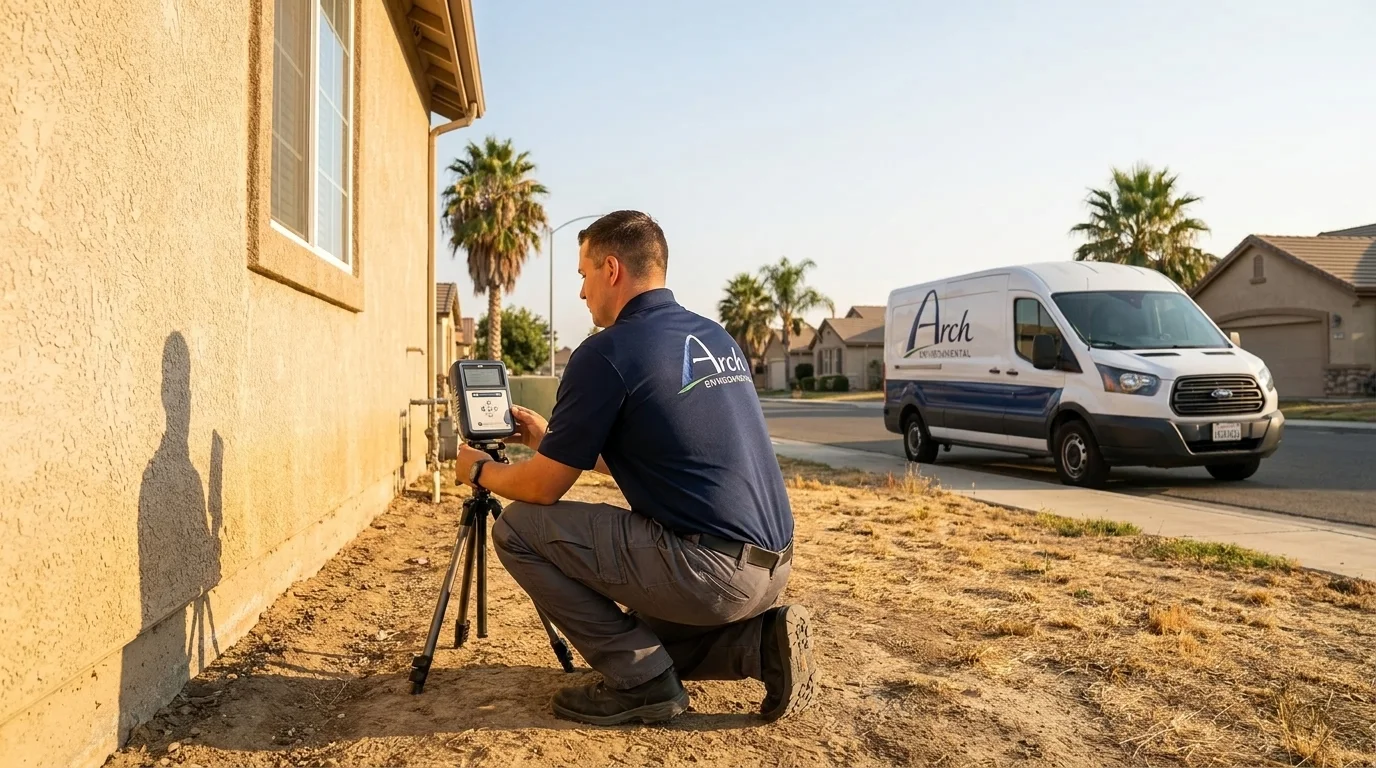
Radon Testing in Kingsburg
Certified radon testing in Kingsburg and surrounding areas. Independent inspections, accredited lab analysis, clear written reports. Call (559) 296-2088.
Radon is colorless, odorless, and tasteless, you cannot detect it without a test, and it accumulates silently in the lower levels of a home over months and years. It’s the second leading cause of lung cancer in the United States, yet most homeowners in the San Joaquin Valley have never had their property tested. If you’re buying, selling, or simply want to know what your family is breathing, a professional radon inspection gives you a defensible, documented answer, not a guess from a hardware-store kit.
What radon testing actually involves
Radon is a naturally occurring radioactive gas that forms when uranium in soil and rock breaks down. It seeps through foundation cracks, slab penetrations, crawl space vents, and even well water. Because it’s heavier than air, it concentrates in basements, crawl spaces, and ground-floor living areas, exactly the spaces where families spend time.
Professional radon testing goes well beyond placing a passive charcoal canister and mailing it to a lab. A thorough radon inspection includes selecting the correct device type for the structure, placing it at the right location and height per EPA and state protocol, maintaining closed-house conditions for the required duration, and interpreting the results in context, not just comparing a number to the 4 pCi/L action level and stopping there.
Arch Environmental Group uses continuous radon monitors (CRMs), electronic devices that record radon concentrations hour by hour throughout the test period. Unlike passive canisters, CRMs produce a time-resolved graph that can reveal whether a spike occurred during a single night (possibly a door left open) or whether elevated levels persisted across the full test window. That distinction matters when you’re deciding whether mitigation is warranted or whether a retest under stricter closed-house conditions is the right next step.
Test duration follows EPA guidance: short-term tests run 48–96 hours minimum under closed-house conditions; long-term tests (90 days or more) use alpha track detectors and capture seasonal variation. For real estate transactions, short-term CRM testing is standard and produces results within days of device retrieval.
Our process
-
Pre-test site evaluation. Before any device is placed, the structure is assessed, foundation type (slab, crawl space, basement), HVAC configuration, and any existing sub-slab depressurization systems. This determines the correct test location and flags conditions that could compromise results, such as a sump pump with an open lid or a crawl space with inadequate vapor barrier.
-
Device placement per protocol. Continuous monitors are placed in the lowest livable area of the home, at the correct height above the floor (typically 20 inches to 6 feet), away from exterior walls, drafts, and high-humidity zones. Closed-house conditions are confirmed and documented at placement.
-
Closed-house monitoring period. The monitor runs for the required duration, typically 48 hours minimum for short-term testing. Homeowners receive clear written instructions on maintaining closed-house conditions: windows closed, exterior doors used only for normal entry and exit, HVAC on normal operation. Deviations during the test period are logged by the CRM’s internal data.
-
Data retrieval and analysis. At the end of the test period, the monitor is retrieved and the hourly data is downloaded. Results are reviewed for anomalies, unusual spikes, pressure fluctuations, or protocol deviations, before a final average is calculated. A reading is not simply a number; it’s a pattern.
-
Written report and next-step guidance. You receive a formal written report with the test results, the measurement methodology, device calibration records, and, if levels are at or above 4 pCi/L, a clear explanation of what mitigation options typically look like and what to expect from a follow-up test after any system is installed.
What separates a good radon inspection from a bad one
The most common failure in residential radon testing is improper placement, devices set too close to exterior walls, in rooms that don’t represent the lowest occupied level, or in spaces with active air movement that dilutes readings. A low result from a poorly placed device is not reassuring; it’s misleading.
A second common problem is ignoring the hourly data. Passive canisters return a single averaged number with no time resolution. If closed-house conditions were violated, a window left open overnight, a contractor working with doors propped, a passive test cannot detect it. A CRM flags those deviations in the data record, which protects both the homeowner and the inspector.
For real estate transactions, buyers’ agents and lenders increasingly require testing performed by a qualified third party using calibrated equipment. A report from a NIOSH 582-trained microscopist and certified environmental consultant carries weight with lenders, insurers, and sellers’ attorneys in a way that a DIY kit result does not.
Finally: a result at 3.9 pCi/L is not “safe”, it’s below the EPA action level, but the EPA itself notes that no level of radon exposure is without risk. A qualified inspector explains what the number means, not just whether it crossed a threshold.
What does radon testing cost?
Typical costs for professional radon testing vary by test type, property size, and whether the report is needed for a real estate transaction or general residential use. Most homeowners pay in the ranges below, these are industry-typical figures, not a quote from Arch Environmental Group.
| Scenario | Typical industry range |
|---|---|
| Short-term CRM test, single-family home | $150 – $300 |
| Short-term test, multi-unit or large home (multiple devices) | $250 – $500 |
| Long-term alpha track test, single-family home | $100 – $200 |
| Real estate transaction test with formal report | $175 – $350 |
| Post-mitigation confirmation test | $100 – $250 |
| Commercial or multi-family building (per zone) | $200 – $600 |
Every property is different, and Arch Environmental Group provides a written scope before any work begins. Homeowners insurance typically does not cover radon testing as a standalone service; however, if radon exposure is identified in connection with a covered loss or an environmental claim, your adjuster may include testing costs, confirm with your carrier.
Seasonal and regional considerations
In the San Joaquin Valley, the dominant soil type, fine-grained alluvial deposits over much of Fresno and Kings counties, can behave unpredictably as a radon source. Radon entry rates tend to increase in winter months when homes are closed up and pressure differentials between the interior and the sub-slab environment are greatest. Homes with concrete slab foundations on expansive clay soils are particularly susceptible to seasonal cracking that opens new entry pathways.
If you test in summer with windows open and HVAC running continuously, a short-term result may understate what your family breathes in January. Closed-house protocol exists precisely to control for this, but it’s worth understanding that a summer test and a winter test on the same home can produce meaningfully different numbers.
Service area
Arch Environmental Group is based in Kingsburg, CA and serves property owners throughout the surrounding San Joaquin Valley, including Fresno, Selma, Hanford, Visalia, Tulare, Clovis, and Reedley. If you’re searching for radon testing near me in Kings or Fresno County, we serve your area. City-specific pages with local permitting and housing-stock notes are linked from the service area index.
Ready to know what the air in your home actually contains? Call (559) 296-2088 to schedule your radon inspection, and get a written report you can act on.
Frequently Asked Questions
What is the EPA action level for radon, and what does it actually mean for my family?
What is the difference between a short-term and a long-term radon test, and which one do I need?
Does homeowners insurance cover radon testing?
Why use a continuous radon monitor instead of a charcoal canister kit from the hardware store?
What closed-house conditions are required during a radon test, and what happens if they aren't maintained?
Looking for the best radon testing company in Kingsburg?
Arch Enviornmental Group LLC provides radon testing in Kingsburg, CA and the surrounding area, and has served local property owners since 2026. Customers rate us 5.0 out of 5 stars across 34 Google reviews. Call (559) 296-2088 to schedule radon testing or request a free estimate.
Schedule Radon Testing
Independent, lab-verified testing across Kingsburg and California's Central Valley.