
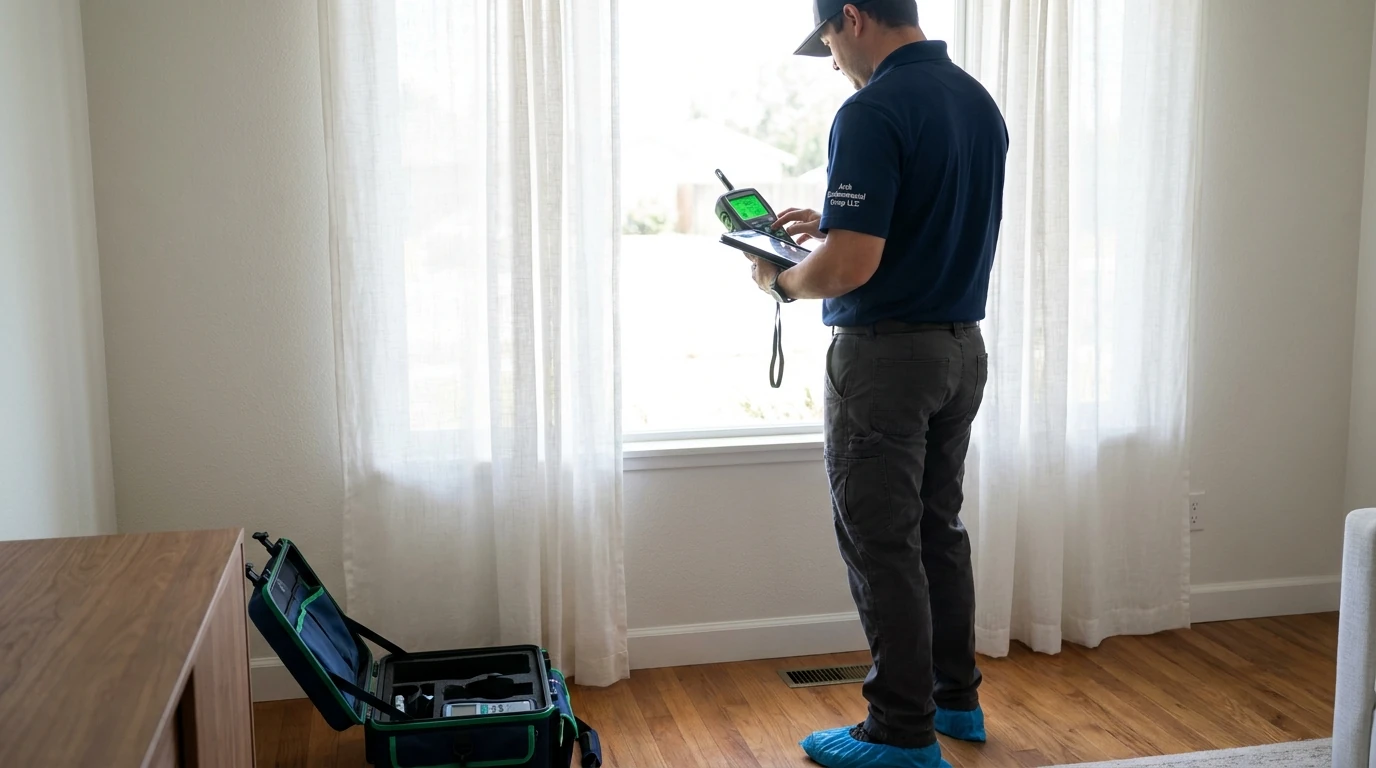
Your indoor air can look perfectly clean and still be making you sick. Unlike a water stain on the ceiling or mold you can see on a wall, air quality problems are invisible, and the symptoms they cause are easy to blame on allergies, a bad night’s sleep, or stress. The seven signs below are the ones most commonly tied to measurable air quality problems. For each one, there’s a specific test that can confirm whether your air is the cause, so you’re not guessing, and you’re not spending money on remediation you may not need.
1. Persistent Headaches That Improve When You Leave the Building
This is one of the clearest behavioral clues that something is wrong indoors. If your headache fades within an hour of leaving home or work, and returns after you’ve been inside for a while, the building itself is the common variable.
What it often indicates: Elevated carbon monoxide (CO), volatile organic compounds (VOCs) from off-gassing furniture or flooring, or inadequate ventilation causing CO₂ buildup.
Test that confirms it: A VOC air sampling test or a CO monitor calibrated for low-level chronic exposure. Standard residential CO detectors are designed to alarm at levels that cause acute poisoning, they won’t alert you to the lower concentrations that cause daily headaches.
2. A Musty or Earthy Smell That Doesn’t Go Away
Mold produces microbial volatile organic compounds (mVOCs) as it grows, that damp, earthy smell is a metabolic byproduct, not just a sign of moisture. The smell can persist even after a surface has dried, because mold colonies inside wall cavities, under flooring, or in HVAC ductwork continue to off-gas into the living space.
If you’ve cleaned visible mold and the smell returned within days, the source is almost certainly behind a surface you can’t see.
Test that confirms it: Air sampling for mold spores (spore trap or PCR-based) combined with a surface or bulk sample from any suspect material. An air test alone can miss localized growth; pairing it with a physical sample gives you a more complete picture. A professional indoor air quality assessment can identify whether spore counts are elevated relative to outdoor baseline levels, which is how you distinguish a true mold problem from normal background spores.
3. Worsening Allergy or Asthma Symptoms Indoors
If your symptoms are worse at home than outside, or worse in one room than another, that pattern is diagnostically useful. Common triggers include dust mite allergens, pet dander concentrated in carpeting, cockroach proteins, and mold spores, all of which are testable.
Test that confirms it: An allergen panel test using settled dust samples (ERMI testing or a targeted allergen immunoassay). These tests quantify specific allergens, dust mite, cat, dog, mouse, cockroach, and several mold species, in a dust sample collected from your floor or HVAC filter. The results tell you which allergen is driving symptoms, which matters because the remediation for dust mites is different from the remediation for mold.
4. Visible Dust Buildup Returning Quickly After Cleaning
Dust is normal. Dust that reappears on surfaces within a day or two of cleaning, or that visibly settles in sunlight streaming through a window, suggests your HVAC system is either pulling in outdoor particulates, recirculating debris from dirty ductwork, or operating without adequate filtration.
In the San Joaquin Valley, this is a particularly common complaint. The region’s agricultural activity and dry summers mean outdoor particulate matter (PM2.5 and PM10) is frequently elevated, and if your home’s envelope isn’t well-sealed, that outdoor air becomes indoor air.
Test that confirms it: Particulate matter monitoring using a calibrated air quality meter. A short-term measurement (24–48 hours) can establish whether indoor PM levels track outdoor levels (a sealing and filtration problem) or whether they’re elevated independently (a source inside the home, like a malfunctioning gas appliance or deteriorating insulation).
5. Condensation on Windows, Walls, or Pipes
Condensation is a humidity problem, and humidity is a mold problem waiting to happen. When indoor relative humidity consistently exceeds 60%, surfaces stay damp long enough for mold to colonize, typically within 24 to 48 hours on organic materials like drywall paper, wood framing, or ceiling tile.
In Kingsburg and the surrounding Central Valley, the pattern is often seasonal: dry summers followed by foggy, damp winters (the Tule fog season) that drive up indoor humidity, especially in older homes with single-pane windows and minimal insulation.
Test that confirms it: A calibrated hygrometer gives you a baseline reading, but a full assessment should include a moisture meter survey of walls, subfloors, and crawl spaces, because condensation on visible surfaces often means hidden moisture in structural materials. If moisture readings are elevated, follow with mold air sampling to determine whether colonization has already begun.
6. Unexplained Fatigue or Difficulty Concentrating
Chronic low-level exposure to CO, radon, or elevated CO₂ can cause cognitive symptoms, brain fog, fatigue, difficulty focusing, without triggering any obvious alarm. These symptoms are frequently misattributed to sleep disorders, depression, or overwork.
Radon is worth calling out specifically: it’s a colorless, odorless radioactive gas that forms from uranium decay in soil and rock. It enters buildings through foundation cracks, crawl spaces, and slab penetrations. The EPA estimates it’s the second leading cause of lung cancer in the U.S. after smoking, and California’s Central Valley has areas with elevated radon potential.
Test that confirms it: A long-term radon test (90+ days using a passive charcoal or electret detector) gives the most accurate result. Short-term tests are useful for initial screening. For CO₂ and CO, continuous monitoring over several days captures the variation that a single-point reading misses.
7. Recent Renovation, New Flooring, or New Furniture
New materials off-gas. Laminate flooring, particleboard cabinets, adhesives, paints, and foam furniture can release formaldehyde and other VOCs for weeks to months after installation. The smell is sometimes obvious; sometimes it’s below the threshold of human detection but still at concentrations that cause irritation.
If symptoms started after a renovation or a significant furniture purchase, the timeline is the clue.
Test that confirms it: A formaldehyde-specific air test (passive badge sampler or active sampling with lab analysis) measures concentration in micrograms per cubic meter. A broader VOC panel can identify other off-gassing compounds if formaldehyde comes back within normal range but symptoms persist.
What to Do If You Recognize These Signs
Knowing the sign is step one. Getting a test that confirms the specific cause is what makes remediation effective, because treating for mold when the problem is radon, or buying an air purifier when the issue is a sealed crawl space off-gassing VOCs, wastes time and money.
If you’re seeing more than one of these signs, or if symptoms are affecting multiple people in the household, a professional indoor air quality assessment is the most efficient path to an answer. Arch Enviornmental Group LLC provides indoor air quality testing for homes and commercial properties in Kingsburg and the surrounding Central Valley. Call (559) 296-2088 to discuss what you’re experiencing, a conversation about your specific symptoms and building history can help determine which tests are actually worth running.