
If someone offers to test your home for mold and remove it for one bundled price, walk away. The conflict of interest is baked into the business model: a remediator who also writes your test results has a financial incentive to find a problem, and an equally strong incentive to declare it solved when the job is done. Keeping those two roles separate is not a bureaucratic formality. It is the only structural protection a homeowner has against paying for work that was never needed, or paying for work that was done poorly and never caught.
The Conflict of Interest Isn’t Subtle
Mold remediation is not a commodity with a fixed price. The scope of work, how many rooms, how many materials get removed, how many containment barriers go up, is determined almost entirely by what the testing says. If the same company writes the test and quotes the job, they control both ends of that equation.
This does not mean every combined-service contractor is dishonest. Some are perfectly competent and well-intentioned. But good intentions are not a substitute for independent verification. A building inspector who also sells the repairs they recommend would raise immediate red flags in any other context. Mold is no different.
California does not currently license mold inspectors or remediators the way it licenses contractors for structural work, which puts more responsibility, not less, on the homeowner to build in their own checks. Choosing an independent tester is one of the most effective checks available.
What Independent Mold Testing Actually Does
A mold inspection and testing engagement, when performed by someone with no financial stake in the remediation outcome, does three things:
- Establishes a baseline. Air and surface samples taken before any work begins document what species are present, at what concentrations, and how those numbers compare to outdoor control samples taken the same day. This is your evidence of the original problem.
- Defines the scope. A written report from an independent inspector gives a remediator, whoever you hire, a clear target. It also gives you a document to hand to your insurance carrier.
- Sets the bar for clearance. This is the part most homeowners don’t think about until it’s too late. Clearance testing, performed after remediation is complete, compares post-work air and surface samples against that original baseline. If the same company runs both tests, they are grading their own homework.
Clearance testing is not optional if you want to know the work actually worked. Post-remediation air samples can look acceptable to the naked eye while spore counts remain elevated, particularly with species like Aspergillus and Penicillium whose spores are small enough to stay airborne long after visible growth has been removed. An independent clearance test is the only way to confirm the space is back to normal fungal ecology.
What Happens When the Same Company Does Both
When a remediator controls the clearance test, a few things become structurally impossible:
- Failed clearance results in more revenue for them. If the post-work test shows elevated counts, they get called back for additional remediation. That is not a neutral position to be in.
- Passed clearance results end their liability. A remediator who issues their own clearance certificate has effectively signed off on their own work. If problems resurface six months later, that certificate becomes a shield.
- You have no independent record. If a dispute arises, with the contractor, with your insurer, or in a real estate transaction, a clearance certificate issued by the same company that did the removal carries almost no evidentiary weight.
None of this requires bad faith. The problem is structural, not personal.
What to Look for in an Independent Mold Tester
When you’re vetting someone to test your home, ask directly: Do you also perform remediation, or do you refer that work to others? The answer should be an unambiguous no to the first part.
Beyond that, look for:
- Accreditation through a recognized body. The American Industrial Hygiene Association (AIHA) and the American Council for Accredited Certification (ACAC) both credential mold inspectors. These credentials indicate training in sampling methodology, chain of custody, and interpretation of laboratory results.
- Third-party laboratory analysis. Samples should go to an accredited environmental lab, not analyzed in-house. The lab report should come to you directly, or at minimum be included in full in the inspector’s written report.
- A written protocol, not just a verbal recommendation. If remediation is warranted, the inspector should provide a written scope of work that any qualified remediator can bid against. This document protects you during the bidding process.
- No referral fees from remediators. Ask. Some inspectors operate on a referral arrangement with remediation companies. That is a softer version of the same conflict.
The Sequence That Protects You
Here is the order of operations that keeps the process honest:
- Independent inspection and testing first. Before anyone touches anything, get a baseline report from a tester with no remediation business.
- Use the written protocol to solicit bids. Get at least two bids from remediators. The protocol gives them a defined scope, so bids are actually comparable.
- Hire a remediator. Choose based on qualifications, references, and price, not on who the inspector recommends unless you have verified there is no referral relationship.
- Independent clearance testing after remediation. Bring the original inspector back, or hire a different independent tester, to run post-work samples. Do not accept a clearance certificate from the remediator.
- Keep all documentation. The baseline report, the remediation contract, the clearance report, and the lab results should all be filed together. You will want them for insurance, for a future sale, or if the problem returns.
This sequence costs more upfront than a bundled quote. It also costs less than paying for remediation twice, or discovering after a sale that a clearance certificate wasn’t worth the paper it was printed on.
A Note on the Central Valley’s Mold Environment
The San Joaquin Valley’s climate creates conditions that make independent oversight especially practical here. Hot, dry summers followed by wet winters, combined with the region’s older agricultural and residential building stock, mean that moisture intrusion events often go undetected until visible growth or a smell surfaces. Crawl spaces under pier-and-beam homes, evaporative cooler pans, and aging stucco exteriors are common entry points in this part of California.
Because the valley’s outdoor fungal background can be elevated (agricultural dust carries its own spore load), interpreting air sample results correctly requires comparing indoor counts to outdoor controls taken the same day under the same conditions. An inspector who understands regional baseline variability will produce a more defensible report than one applying a generic national standard without that context.
If You’re at This Stage, Here’s What to Do Next
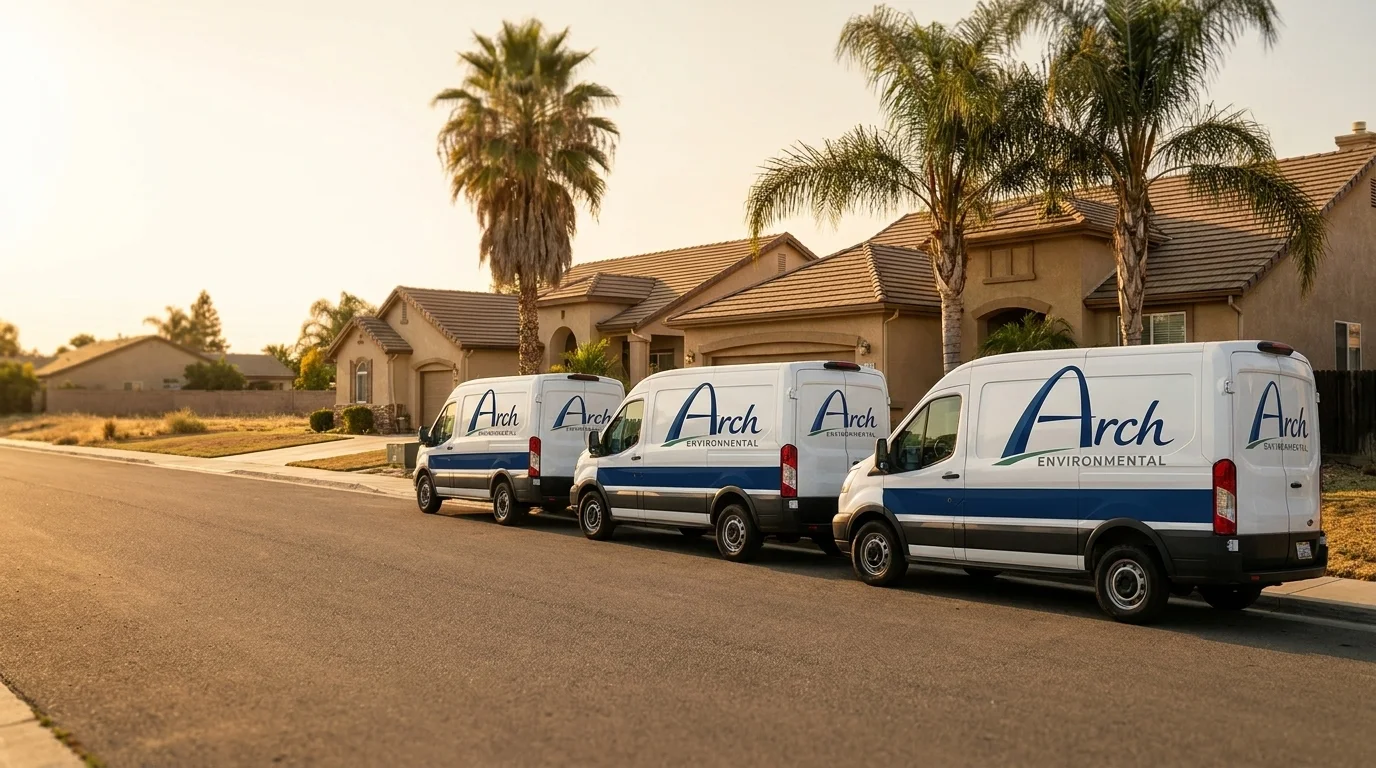
If you have a suspected mold problem, a stain, a smell, an unexplained respiratory irritation, or a recent water event, the right first call is to an independent inspector, not a remediator. Arch Environmental Group LLC provides mold inspection and testing services in Kingsburg and the surrounding Central Valley, and clearance testing after remediation is complete. We do not perform remediation, which means our findings have no financial stake attached to them. Reach us at (559) 296-2088 if you want a baseline assessment or a post-remediation clearance test you can actually rely on.