
Post-Flood Mold Assessment in Squaw Valley
Certified post-flood mold assessment in Squaw Valley, CA. Independent inspections with accredited lab analysis. Call (559) 296-2088.
Our crews are dispatched from our Kingsburg, CA headquarters and respond quickly to projects across Squaw Valley.
Squaw Valley sits in the Sierra Nevada foothills where snowmelt, seasonal storms, and the region’s granitic soil create drainage conditions that push water into structures in ways flatland properties rarely experience. When a flood event soaks a home here, the combination of cool nighttime temperatures, dense wood-framed construction, and limited airflow in crawl spaces and lower levels creates conditions where mold can begin colonizing hidden surfaces within 24 to 48 hours of saturation. A post-flood mold assessment is not a precaution in this environment; it is a necessary step before any reconstruction work begins.
Why Squaw Valley Properties Face Elevated Mold Risk After Flooding
The Sierra Nevada climate that makes Squaw Valley a destination also makes it a challenging environment after a water loss. Structures here tend to be built for insulation rather than ventilation, with tight envelopes designed to hold heat through long winters. That same tightness traps moisture after a flood. Crawl spaces over native soil are common in the area, and when groundwater or snowmelt intrudes, the soil itself becomes a moisture reservoir that continues releasing humidity long after standing water is removed.
Wood-framed walls and subfloors in mountain construction absorb water deeply. A surface moisture reading can show acceptable numbers while the structural lumber behind the drywall or beneath the subfloor remains saturated. Mold does not wait for surface readings to normalize. Spore colonization begins in the substrate, not at the surface, which is why visual inspection alone is never sufficient after a flood in this region.
Our Post-Flood Mold Assessment Process in Squaw Valley
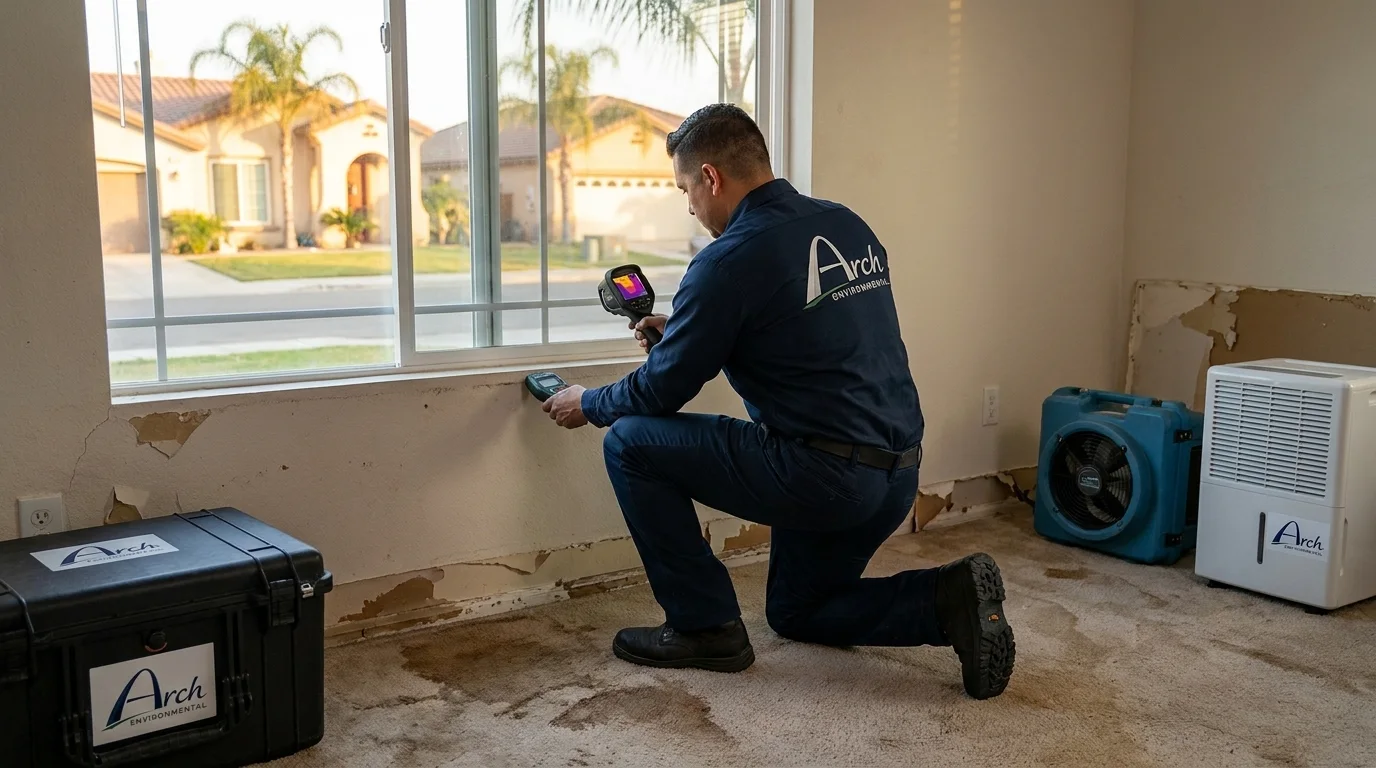
Arch Environmental Group’s assessment process is built around what actually happens to a flooded structure, not a checklist designed for a generic suburban home. The process begins with moisture mapping using calibrated meters and thermal imaging to identify wet zones that are not visible to the eye. Wall cavities, subfloor assemblies, and ceiling planes adjacent to the flood source are all documented before any sampling begins.
Air sampling captures the spore load currently circulating in the living space, giving a baseline that reflects actual occupant exposure risk. Surface sampling targets areas where moisture mapping shows elevated readings, particularly at the wall-floor junction and inside any wall cavity that was opened during initial water removal. All samples are analyzed by an accredited laboratory, and results are interpreted by a certified assessor, not a general contractor with a test kit.
Because Arch Environmental Group holds certifications as a Certified Asbestos Consultant and Lead Inspector Assessor, properties built before 1980 receive an additional review for disturbed lead paint and asbestos-containing materials during the assessment. In older Sierra Nevada construction, flood damage frequently disturbs these materials alongside the mold concern, and addressing them together prevents a second round of testing and remediation delays.
Reaching Squaw Valley from Kingsburg
Arch Environmental Group is based in Kingsburg, in the San Joaquin Valley. Squaw Valley is located in the foothills of Fresno County, accessible via State Route 180 heading east from the valley floor. Scheduling is handled by phone at (559) 296-2088, and the team coordinates arrival times directly with the property owner or their contractor. Because mountain road conditions can shift with weather, especially during the same storm events that cause flooding, clients are encouraged to call as soon as the water event is controlled so scheduling can account for any access considerations on the route.
Local Note
Properties in the Squaw Valley area that draw from private wells rather than municipal water systems face a compounding issue after a flood: well contamination and structural mold often occur simultaneously, and remediation contractors focused on the building sometimes do not flag the water source as a concern. During an assessment in this part of Fresno County, it is worth confirming whether the structure uses a private well and whether the flood event may have introduced surface water into the well casing. That context shapes the full scope of what needs to be addressed before a home is safe to reoccupy, and it is the kind of detail that a thorough environmental assessment should surface.
If you have experienced flooding in Squaw Valley and are uncertain whether mold has taken hold in wall cavities, under flooring, or in the crawl space, the window for early intervention is short. Contact Arch Environmental Group at (559) 296-2088 to schedule a post-flood mold assessment before reconstruction work covers the evidence.
Serving Squaw Valley from our Kingsburg headquarters — ★ 5.0 · 34 Google reviews
“Very impressed with Arch Environmental's professionalism. I called during the week, forget which day, but they had somebody out here in Bakersfield the following day to do the testing. Overall I'm satisfied. It didn't take much effort from my part. 5/5” — J, September 2026Read our reviews on Google →
Post-Flood Mold Assessment in Squaw Valley: Service Coverage
Frequently Asked Questions
How does Squaw Valley's mountain climate affect how quickly mold develops after a flood?
Do older homes in the Squaw Valley area require additional testing beyond standard mold sampling?
What does a post-flood mold assessment in Squaw Valley actually involve on the day of the inspection?
Can a post-flood mold assessment in Squaw Valley support an insurance claim?
What is the risk of skipping a mold assessment and going straight to reconstruction after a flood in Squaw Valley?
Post-Flood Mold Assessment in Squaw Valley
Our crews are based in Kingsburg, CA and take on projects across Squaw Valley. Call for a free estimate.