
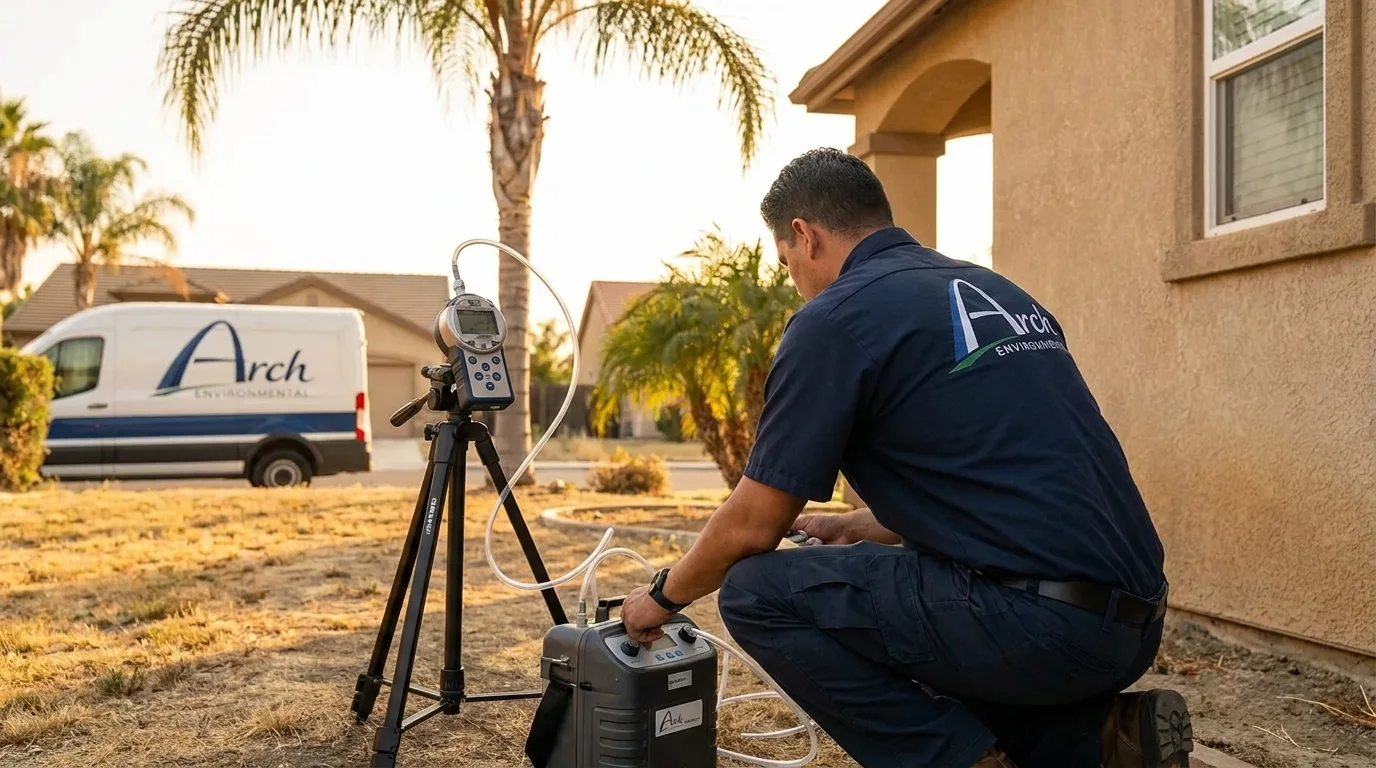
VOC and Formaldehyde Testing in Kingsburg
Certified voc and formaldehyde testing in Kingsburg and surrounding areas. Independent inspections, accredited lab analysis, clear written reports. Call (559) 296-2088.
That sharp, chemical smell in a freshly painted room or newly installed floor might fade from your awareness after a few days, but the compounds causing it don’t necessarily leave. Volatile organic compounds (VOCs) and formaldehyde off-gas from building materials, adhesives, cabinetry, and furnishings for weeks or months after installation. Headaches, eye irritation, and a persistent chemical odor are often the first signs that indoor air quality has crossed a threshold worth measuring. VOC and formaldehyde testing puts a number on what you’re breathing, so you can act on evidence rather than guesswork.
What VOC and Formaldehyde Testing actually involves
Testing for VOCs and formaldehyde is not a single-instrument pass through a room. These compounds exist at different concentrations in different microclimates, near the floor where laminate adhesives off-gas, at breathing height, and near HVAC return vents that can concentrate or dilute airborne chemicals depending on system operation.
Formaldehyde is measured separately from the broader VOC panel because it requires its own sampling media and analytical method. Passive diffusion badges or active sorbent tube sampling, drawn at a calibrated flow rate using a pump, collect airborne formaldehyde over a defined period, typically one to eight hours, then go to an accredited laboratory for analysis. Results are reported in parts per million (ppm) or micrograms per cubic meter (µg/m³) and compared against reference values from agencies such as OSHA, NIOSH, and the California Office of Environmental Health Hazard Assessment (OEHHA), which sets some of the most protective chronic reference exposure levels in the country.
For the broader VOC panel, TO-15 or TO-17 canister and sorbent-tube methods capture dozens of individual compounds, benzene, toluene, xylenes, styrene, and others, that a simple photoionization detector (PID) reading in the field cannot speciate. A PID gives a total-VOC number that is useful for screening but tells you nothing about which compounds are present or at what individual concentrations. Laboratory speciation is what makes a report defensible to a building department, a landlord, or an insurance adjuster.
Sampling conditions matter as much as equipment. Closed-building conditions (windows shut, HVAC running normally for at least one hour prior) are standard protocol for residential off-gassing assessments. Testing a newly built home in Kingsburg during a Central Valley summer, when interior temperatures can climb well above 80°F, will produce higher off-gassing rates than a winter test of the same materials, because VOC emission rates increase with temperature. That context belongs in every written report.
Our process
-
Pre-sampling consultation and building review. Before any media is deployed, the sampling strategy is scoped to the complaint: new construction odor, a specific product installation, or a long-standing chemical smell with no obvious source. Floor plan, HVAC configuration, recent renovation history, and occupant symptoms are all documented.
-
Closed-building conditioning. The space is closed to outdoor air for a standardized period prior to sampling. HVAC is set to normal operating mode. This step is non-negotiable, it ensures results reflect actual occupant exposure conditions rather than a ventilated snapshot.
-
Active and passive sample collection. Formaldehyde badges or sorbent tubes are deployed at breathing height and, where relevant, near identified source materials. VOC canisters or sorbent tubes are placed per the sampling plan. Field blanks travel with every sample set to document contamination controls. A calibrated PID reading is recorded at each location as a field reference.
-
Accredited laboratory analysis. Samples are shipped under chain-of-custody to an accredited laboratory. Formaldehyde is analyzed by HPLC per NIOSH 2016 or equivalent. VOCs are speciated by GC/MS per EPA TO-15 or TO-17. Turnaround is typically five to ten business days for standard analysis; rush options are available.
-
Written report with actionable findings. Results are compared against applicable reference values, California’s OEHHA chronic RELs, OSHA PELs, and ASHRAE 62.2 ventilation guidance where relevant. The report identifies which compounds exceed thresholds, probable source categories, and recommended next steps, whether that is source removal, increased ventilation, or a follow-up clearance sample after mitigation.
What separates a good VOC and Formaldehyde Testing response from a bad one
The most common shortcut in this field is relying exclusively on a handheld PID to report “total VOCs” and calling it done. A PID cannot distinguish formaldehyde from acetone from benzene, it responds to the sum of ionizable compounds and produces a number that looks precise but is analytically meaningless for health-based decisions. A report built on PID data alone will not satisfy a building department, a real estate disclosure requirement, or a legal proceeding.
A second frequent failure is sampling under ventilated conditions, windows open, fans running, which systematically underestimates exposure. This is particularly relevant in the Central Valley, where contractors and property managers sometimes air out a space before testing to reduce odors, inadvertently producing results that don’t reflect what occupants actually breathe.
Finally, results without context are nearly useless. A formaldehyde reading of 0.05 ppm means something different in a newly constructed home than in a space where the occupant has been symptomatic for two years. A defensible report names the reference value being applied, explains why it was chosen, and states clearly whether the measured concentration is above or below it.
What does VOC and Formaldehyde Testing cost?
Typical costs for VOC and formaldehyde testing depend on the number of samples, the analytical methods required, and whether a full written report with health-based interpretation is included. Most property owners pay somewhere in the ranges below, these are industry-typical figures, not a quote from Arch Environmental Group.
| Scenario | Typical industry range |
|---|---|
| Single-room formaldehyde screening (1–2 samples) | $300 – $600 |
| Whole-home formaldehyde assessment (3–6 samples) | $600 – $1,200 |
| Full VOC panel, single room (TO-15 canister) | $500 – $900 |
| Multi-room VOC and formaldehyde survey | $1,200 – $2,500 |
| New construction air quality certification package | $1,500 – $3,000 |
| Clearance re-test after mitigation (2–3 samples) | $300 – $700 |
Every property is different, sample count, building size, and analytical turnaround all affect the final number. Arch Environmental Group provides a written scope and cost estimate before any work begins. Homeowners insurance rarely covers routine air quality testing, but policies that include an indoor air quality rider or that respond to a documented sudden loss (such as a chemical spill or product failure) may provide partial coverage, review your policy declarations and ask your adjuster specifically about environmental testing endorsements.
Seasonal and regional considerations
The Central Valley’s climate is directly relevant to off-gassing assessments. Summer interior temperatures in Kingsburg and surrounding communities regularly exceed conditions under which building material emission rates were characterized in laboratory studies, meaning real-world off-gassing can be meaningfully higher than manufacturer-published emission data suggests. Testing conducted in July or August will typically capture peak emission conditions; testing the same space in December may produce lower readings from the same materials. If the goal is a worst-case exposure assessment, summer sampling is the more conservative choice. If the goal is demonstrating that a remediated space meets a health-based threshold, a post-mitigation test conducted under normal seasonal conditions is appropriate.
New construction activity in Fresno County and the surrounding San Joaquin Valley has remained active, and composite wood products, engineered flooring, cabinetry, and OSB sheathing, remain common formaldehyde sources in tract and custom homes alike, even as CARB Phase 2 and TSCA Title VI have tightened allowable emission limits on these products.
Service area
Arch Environmental Group is based in Kingsburg and serves property owners, contractors, and real estate professionals throughout the Central Valley, including Fresno, Visalia, Tulare, Hanford, Clovis, Selma, Reedley, and surrounding communities. City-specific service pages are linked from the navigation above.
If you’ve noticed a persistent chemical odor, recently completed a renovation, or are preparing a new construction home for occupancy, the next step is a sampling plan, not a guess. Call (559) 296-2088 to schedule your VOC and formaldehyde assessment.
Frequently Asked Questions
What is the difference between a total-VOC reading and a laboratory VOC panel, and which one do I actually need?
How long does formaldehyde continue to off-gas from new flooring or cabinetry?
Does homeowners insurance cover VOC and formaldehyde testing?
What reference levels are used to interpret formaldehyde results, and who sets them?
What should I do, or avoid doing, before a VOC or formaldehyde test to make sure the results are accurate?
Looking for the best voc and formaldehyde testing company in Kingsburg?
Arch Enviornmental Group LLC provides voc and formaldehyde testing in Kingsburg, CA and the surrounding area, and has served local property owners since 2026. Customers rate us 5.0 out of 5 stars across 34 Google reviews. Call (559) 296-2088 to schedule voc and formaldehyde testing or request a free estimate.
Schedule VOC and Formaldehyde Testing
Independent, lab-verified testing across Kingsburg and California's Central Valley.
Related Coverage
- Our Environmental Testing Services
- Contact Arch Enviornmental Group LLC
- VOC and Formaldehyde Testing in Clovis
- VOC and Formaldehyde Testing in Dinuba
- VOC and Formaldehyde Testing in Fowler
- VOC and Formaldehyde Testing in Fresno
- VOC and Formaldehyde Testing in Reedley
- VOC and Formaldehyde Testing in Sanger
- VOC and Formaldehyde Testing in Selma
- VOC and Formaldehyde Testing in Visalia