
TL;DR: Lead testing identifies lead-based paint, dust, or soil in homes built before 1978, the year the federal government banned residential lead paint. A certified lead inspector uses an XRF analyzer for instant paint readings, plus lab-analyzed dust wipe or soil samples to confirm hazards, usually in a single visit. Testing is required before certain renovations on older homes, recommended before buying one, and often needed to settle a landlord-tenant dispute. Results tell you whether abatement is needed and support compliance with EPA’s Renovation, Repair, and Painting Rule.
If you’re pulling permits to remodel a 1950s farmhouse near Old Town Clovis, or a tenant complaint about peeling paint just landed on your desk as a landlord in Fresno County, the question isn’t whether lead paint might be present. It’s how you prove it, one way or the other, before a contractor opens a wall or a tenant dispute turns into a legal one. Lead testing is the step that turns a guess into documentation.
What Is Lead Testing and When Do You Actually Need It?
Lead testing is a sampling process that checks painted surfaces, settled dust, water, or soil for lead content above regulatory action levels. You need it before renovating or demolishing any part of a home or building built before 1978, before buying an older property, when a child in the home has an elevated blood lead level, or when a rental unit’s paint condition is in question.
California’s older housing stock makes this a routine question across the Central Valley. Much of Old Town Clovis, along with pockets of Fresno, Selma, and Reedley, was built well before the 1978 federal cutoff, when lead was still a standard additive in residential paint. A 1940s bungalow with original window trim or a 1960s ranch home with repainted eaves can both carry lead paint several coats deep, invisible until it’s tested.
Federal law under the EPA’s Lead-Based Paint program requires certified renovation contractors to test or presume lead paint is present before disturbing more than a small surface area in pre-1978 housing. A negative lead test lets the project proceed under standard rules; a positive result triggers lead-safe work practices under the Renovation, Repair, and Painting (RRP) Rule.
How Does a Professional Lead Inspection Actually Work?
A professional lead inspection combines instant on-site readings with lab-confirmed samples, giving you both immediate direction and defensible documentation. The two core tools are an XRF (X-ray fluorescence) analyzer and dust wipe or soil sampling sent to an accredited laboratory.
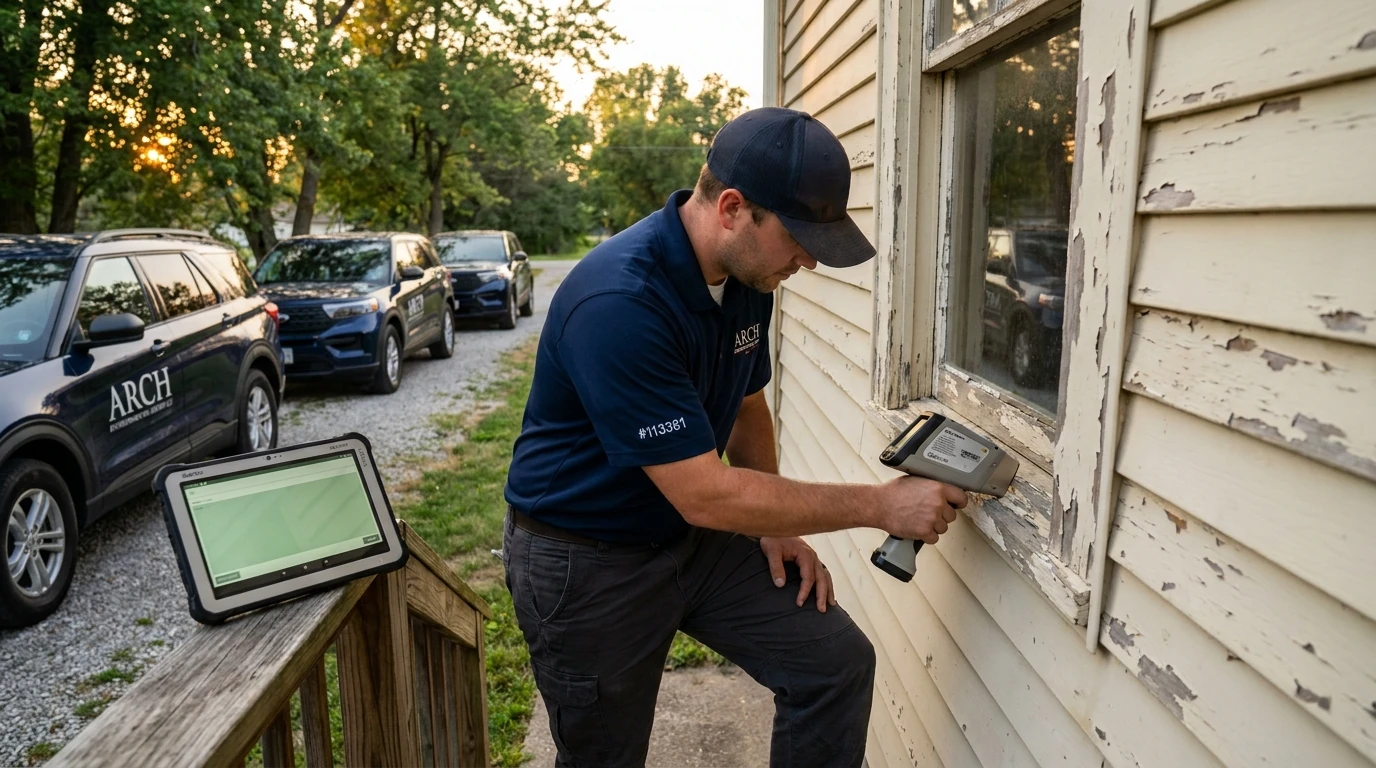
The inspector uses a handheld XRF analyzer directly on painted surfaces, window casings, door frames, baseboards, exterior siding, reading lead content in seconds without damaging the surface. Because paint can vary layer by layer and room by room, a thorough inspection tests multiple components throughout the property, not just one wall.
Where dust or soil exposure is a concern, particularly for rentals, daycare-adjacent properties, or homes with young children, the inspector collects dust wipe samples from windowsills, floors, and window troughs, and soil samples from bare play areas near the foundation. These go to a third-party laboratory for analysis against EPA and HUD clearance standards. Typical lab turnaround for this kind of work runs 24 to 72 hours, which matters when a renovation permit or a closing date is on the clock.
Our inspectors hold current Lead Inspector/Assessor certification, so the same visit that generates XRF readings also produces a report structured for compliance use, whether that’s a real estate disclosure, a permit file, or a tenant response.
What Should You Do If Testing Finds Lead?
A positive result means the next step is hiring a qualified lead abatement or lead-safe renovation contractor, not calling the same company back to fix what they found. Because we perform testing only, we have no incentive to find a problem that isn’t there, and our report is written to work with whichever licensed contractor you choose.
The contractor’s scope depends on what the report shows. Intact lead paint in good condition may only require encapsulation or lead-safe work practices during renovation. Deteriorated paint, contaminated dust, or elevated soil lead typically calls for abatement: removal or permanent sealing performed under containment, following EPA-mandated lead-safe procedures.
Once that work is finished, the property needs independent clearance testing before anyone moves back in or a renovation crew resumes work in the area. Clearance testing should never come from the same contractor who did the abatement, that’s a conflict of interest built into the job. An independent post-work inspection with fresh dust wipe sampling is what actually confirms the space is safe, and it’s the same standard used for our post-remediation verification work after mold and other remediation projects. If you’re weighing renovation timing against lead concerns more broadly, our piece on asbestos testing before renovation covers the same pre-1978 housing questions from the asbestos side, and the two often come up in the same older home.
What Does Lead Testing Cost, and How Do You Get Started?
Most residential lead inspections in the Central Valley run a few hundred dollars for a standard paint and dust screening, with the exact price depending on the number of components tested, whether soil sampling is included, and how quickly you need lab-confirmed results. Every property is different, so we provide a written scope and price before any testing begins.
Rental property owners, buyers under a closing deadline, and homeowners planning a permit-triggering remodel are the most common callers. If you manage several rental units in Fresno, Clovis, or Visalia, compliance consulting can also help structure ongoing lead-disclosure and tenant-notification obligations across a portfolio, rather than reacting property by property.
Start with a phone call describing your situation, whether it’s a renovation permit, a tenant complaint, or a pending sale, and we’ll scope the right combination of XRF, dust, and soil sampling for that specific property.
A lead test is a small, fast step compared to what it protects you from: a stalled permit, a failed disclosure, or a health question you can’t answer with confidence. Arch Environmental Group LLC’s inspectors handle the sampling and the paperwork so you can make the next decision with real numbers in hand.
About Arch Environmental Group LLC
Arch Environmental Group LLC is an independent environmental testing company serving Kingsburg, CA and the surrounding Central Valley, including Fresno, Clovis, Visalia, and Selma. Their inspectors hold Certified Asbestos Consultant, Lead Inspector/Assessor, and NIOSH 582 microscopist credentials, and the company is licensed and insured. Arch Environmental Group LLC handles lead paint testing, asbestos testing, mold inspection, indoor air quality testing, and related environmental sampling services, with all lab work performed by accredited third-party laboratories.