
Sewage Contamination Assessment in Kingsburg
Certified sewage contamination assessment in Kingsburg and surrounding areas. Independent inspections, accredited lab analysis, clear written reports. Call (559) 296-2088.
Sewage backup leaves more than a mess, it leaves Category 3 contaminated water carrying bacteria, viruses, and pathogens that don’t disappear when the water is pumped out. The surfaces that absorbed that water, the air above it, and the materials beneath it can all remain biologically active long after visible moisture is gone. A sewage contamination assessment establishes exactly what is contaminated, how far it spread, and whether a cleanup has actually returned the space to safe, habitable conditions, questions that visual inspection alone cannot answer.
What sewage contamination assessment actually involves
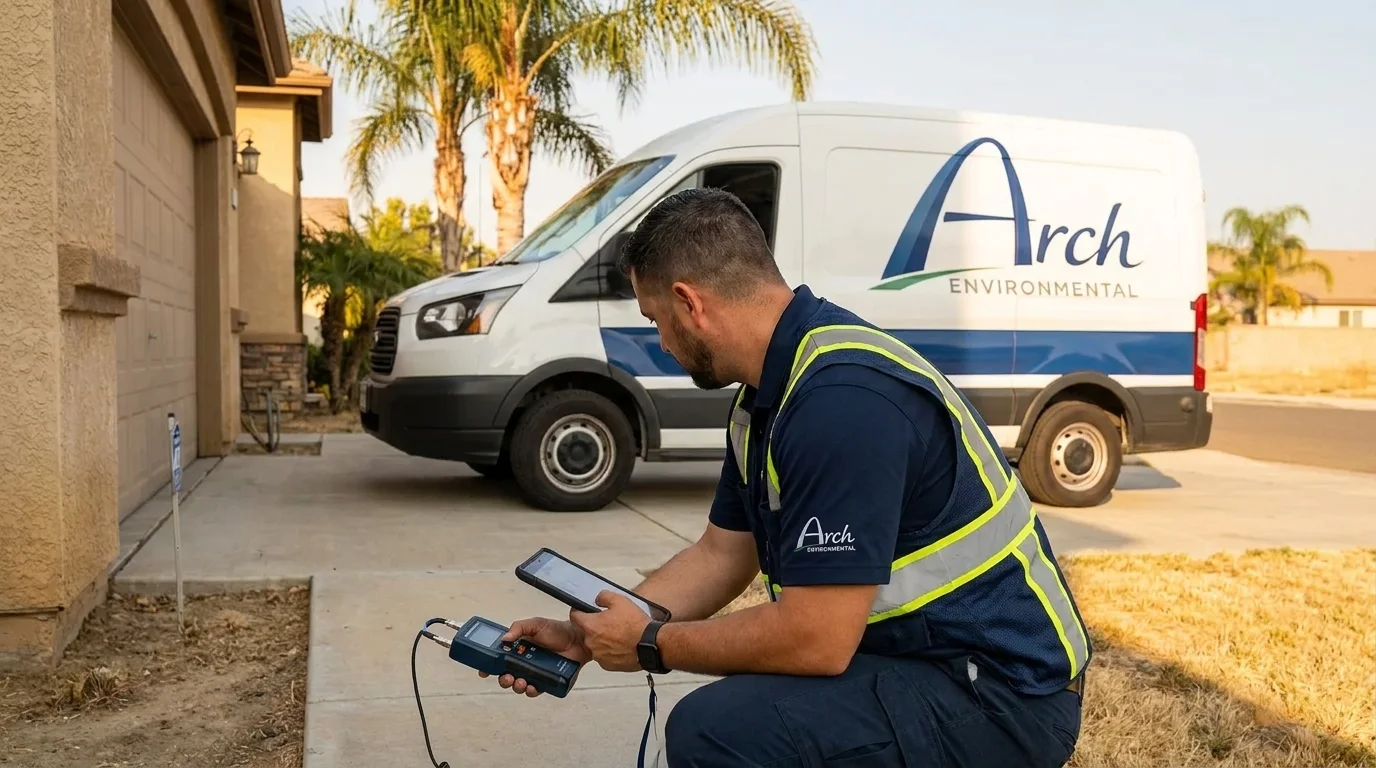
Sewage contamination assessment is an environmental testing service, not a cleanup service. The goal is to produce defensible, laboratory-verified data about the presence and concentration of fecal indicator bacteria, pathogens, and related contaminants in affected building materials, surfaces, and air.
Field work typically involves collecting surface swab samples from flooring, wall cavities, subfloor assemblies, and HVAC components within the affected zone, as well as bulk material samples where porous materials like drywall or insulation absorbed contaminated water. In some losses, air sampling is added to assess aerosolized particulate in the breathing zone. All samples are submitted to an accredited laboratory for analysis, coliform counts, E. coli presence, and pathogen screening depending on the scope of the loss.
Timeline matters here. Bacterial colonization in warm, moist building cavities can progress quickly, and materials that read structurally sound may still harbor active contamination. Assessment results guide the remediation scope, prevent over-demolition of unaffected materials, and provide the documentation that insurance carriers and public health authorities require before a property is reoccupied.
Our process
-
Site review and contamination mapping. Before any samples are collected, the affected area is walked to identify the source of the backup, the direction water traveled, and which materials, flooring, wall cavities, subfloor, cabinetry, were in contact with Category 3 water. This mapping determines where samples will be most informative.
-
Surface and bulk sample collection. Swab samples are taken from hard surfaces within and at the perimeter of the contaminated zone. Where porous materials are present, bulk samples may be collected for laboratory analysis. Sample locations are photographed and logged to create a defensible chain of custody.
-
Laboratory analysis. Samples are submitted to an accredited environmental laboratory for bacterial indicator testing, typically total coliform and E. coli, along with any pathogen panels appropriate to the loss. Results are typically returned within one to three business days depending on the laboratory’s standard turnaround.
-
Written assessment report. Laboratory results are compiled into a written report that maps contamination findings to specific locations, identifies materials requiring remediation, and establishes baseline data for post-remediation verification. This report is formatted for insurance carrier review and can support a public adjuster or attorney if the claim is disputed.
-
Post-remediation clearance testing. After a contractor completes sewage cleanup, a second round of sampling verifies that affected surfaces have been returned to acceptable bacterial levels. Clearance testing is the step that closes the loop, without it, neither the property owner nor the insurance carrier has objective confirmation the remediation was successful.
What separates a good sewage contamination assessment from a bad one
The most common failure in sewage contamination work is sampling only the obvious area. Sewage water follows gravity and capillary action, it travels under flooring, wicks up wall framing, and can reach HVAC return plenums that are nowhere near the original backup point. An assessment that samples only the visible wet zone will miss lateral migration and leave contaminated materials in place.
A second common gap is skipping post-remediation verification. Cleanup contractors may perform thorough work, but without independent clearance sampling, there is no laboratory-backed confirmation. Insurance adjusters increasingly require clearance data before closing a claim, and property managers who skip this step can face liability if occupants report illness after reoccupancy.
Finally, chain of custody documentation matters. Samples collected without proper field logs, labeled containers, and laboratory submission forms cannot be used in a disputed claim or legal proceeding. Every sample collected in a professional assessment travels with a documented chain of custody from the field to the laboratory report.
What does sewage contamination assessment cost?
Assessment costs vary based on the size of the affected area, the number of samples required, laboratory turnaround time, and whether post-remediation clearance testing is included. Typical industry costs run as follows, these are representative ranges, not a quote from Arch Environmental Group:
| Scenario | Typical industry range |
|---|---|
| Single bathroom, localized backup | $400 – $900 |
| Single room with subfloor involvement | $700 – $1,500 |
| Multi-room spread, residential | $1,200 – $2,800 |
| Post-remediation clearance testing only | $350 – $800 |
| Commercial property, multi-zone assessment | $2,000 – $5,500 |
| Full assessment + clearance (combined) | $1,500 – $4,000 |
Every loss is different, and Arch Environmental Group provides a written scope before any work begins. Homeowners insurance policies that include sudden and accidental sewage backup coverage typically cover assessment and testing costs as part of the documented claim, your policy language and endorsements determine what applies.
Seasonal and regional considerations
In California’s San Joaquin Valley, aging clay sewer laterals, common in Kingsburg and surrounding communities built through the mid-twentieth century, are prone to root intrusion and collapse, particularly after the wet season when soil shifts around pipe joints. A backup that appears to be a one-time event may signal a lateral that will fail again. Assessment documentation that captures the full contamination picture is especially useful in these situations when a homeowner is negotiating with a municipality or utility over lateral responsibility.
Summer heat accelerates bacterial growth in affected building cavities, compressing the window between a backup event and active colonization of porous materials. Prompt assessment scheduling matters more in the Central Valley’s warm months than it does in cooler climates.
Service area
Arch Environmental Group is headquartered in Kingsburg and provides sewage contamination assessment throughout the surrounding San Joaquin Valley, including Fresno, Selma, Hanford, Visalia, Tulare, Reedley, and Clovis. City-specific service pages link back to this page for full service detail.
If your property has been affected by a sewage backup and you need laboratory-verified contamination data, for your insurance claim, your remediation contractor, or your own peace of mind, call Arch Environmental Group at (559) 296-2088 to schedule your sewage contamination assessment.
Frequently Asked Questions
Does homeowners insurance cover sewage contamination assessment and testing?
What is Category 3 water and why does it require laboratory testing rather than just visual inspection?
How far does sewage contamination typically spread beyond the visible wet area?
What is post-remediation verification testing and when is it required?
How long does the assessment process take from site visit to written report?
Looking for the best sewage contamination assessment company in Kingsburg?
Arch Enviornmental Group LLC provides sewage contamination assessment in Kingsburg, CA and the surrounding area, and has served local property owners since 2026. Customers rate us 5.0 out of 5 stars across 34 Google reviews. Call (559) 296-2088 to schedule sewage contamination assessment or request a free estimate.
Schedule Sewage Contamination Assessment
Independent, lab-verified testing across Kingsburg and California's Central Valley.
Related Coverage
- Our Environmental Testing Services
- Contact Arch Enviornmental Group LLC
- Sewage Contamination Assessment in Clovis
- Sewage Contamination Assessment in Dinuba
- Sewage Contamination Assessment in Fowler
- Sewage Contamination Assessment in Fresno
- Sewage Contamination Assessment in Reedley
- Sewage Contamination Assessment in Sanger
- Sewage Contamination Assessment in Selma
- Sewage Contamination Assessment in Visalia