
Remediation Oversight and Project Management in Kingsburg
Certified remediation oversight and project management in Kingsburg and surrounding areas. Independent inspections, accredited lab analysis, clear written reports. Call (559) 296-2088.
When a contractor tells you the remediation is done, how do you know they’re right? Without independent oversight, “complete” often means the visible material is gone, not that airborne spore counts have returned to background levels, not that containment held throughout the project, and not that the scope of work your insurance carrier approved is what actually got performed. Remediation oversight and project management puts a certified, third-party set of eyes on the entire process: from the written protocol before a single tool touches the wall to the clearance sampling that closes the project.
What remediation oversight and project management actually involves
Oversight is not inspection after the fact. It begins before the remediation contractor mobilizes, with a written scope of work that defines the extent of affected materials, the containment requirements, the engineering controls (negative air pressure, HEPA filtration, decontamination chambers), and the clearance criteria the project must meet before containment comes down.
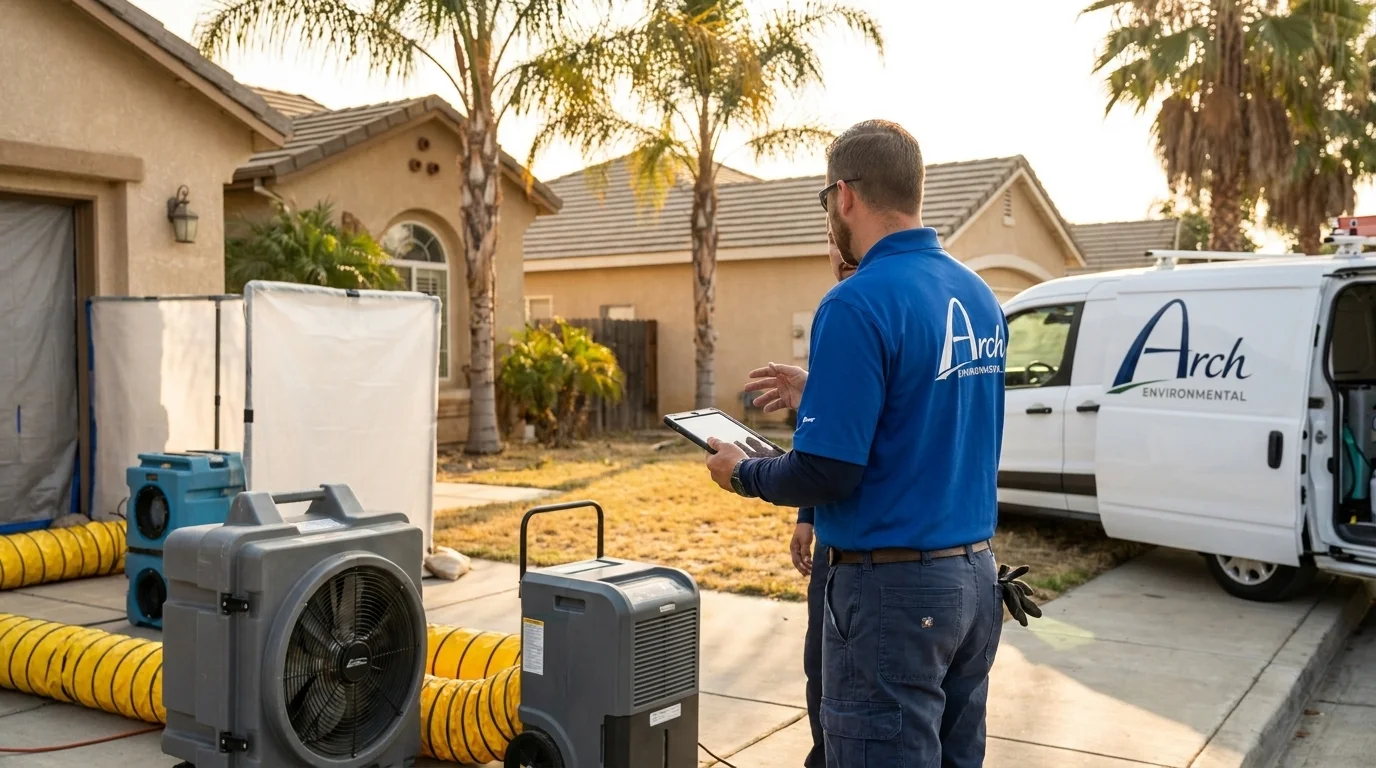
During active abatement, a project monitor verifies that the contractor is following the protocol, that poly barriers are sealed, that workers are in appropriate PPE, that waste is being containerized and staged correctly, and that no cross-contamination is occurring in unaffected areas of the building. This is where problems surface in real time rather than in a post-project dispute.
At project close, clearance sampling, air, surface, or both depending on the contaminant, confirms that the remediation met the protocol’s criteria. That clearance report is what your insurance carrier, your lender, and any future buyer will ask for. It is also what protects you if the contractor’s work is later called into question.
For mold projects, oversight is structured around the IICRC S520 standard. For asbestos and lead, California’s regulatory framework governs both the abatement work and the monitoring requirements. Arch Environmental Group holds the credentials to work across all three: Certified Asbestos Consultant, Lead Inspector/Assessor, and NIOSH 582 Microscopist, the fiber-identification certification required to analyze air samples collected during asbestos abatement.
Our process
-
Pre-remediation protocol development. Before work begins, we produce a written remediation scope of work that identifies affected materials, defines containment boundaries, specifies engineering controls, and establishes the clearance standard. This document is what the contractor bids from and what the project is held to.
-
Contractor pre-construction meeting. We walk the site with the abatement crew before mobilization to confirm they understand the containment design, waste-handling requirements, and any site-specific constraints, access routes, occupied adjacent spaces, utility shutoffs.
-
Active project monitoring. During abatement, we conduct periodic site visits to verify containment integrity, confirm workers are following decontamination procedures, document conditions with photographs, and flag deviations from the protocol in writing. Frequency depends on project size and contaminant type.
-
Waste and documentation review. We review waste manifests, disposal receipts, and contractor daily logs to confirm that regulated materials left the site through a licensed disposal chain. Gaps in the paper trail create liability that can surface years later during a property transaction.
-
Clearance sampling and final report. Post-remediation sampling follows the protocol’s specified method, NIOSH 7400 or TEM for asbestos fibers, spore-trap or culture sampling for mold, XRF or wipe sampling for lead dust. Results are compared against the clearance criteria. If the project passes, we issue a written clearance report. If it does not, we document what remains and what corrective work is required before re-sampling.
What separates a good remediation oversight response from a bad one
The most common failure in unmonitored remediation is scope creep in reverse, contractors removing less than the protocol requires because no one is watching. Mold-stained framing members get wire-brushed instead of removed. Asbestos-containing texture is disturbed rather than encapsulated or abated. These shortcuts are invisible once drywall goes back up.
On the documentation side, insurance adjusters and industrial hygienists reviewing a claim after the fact look for three things: a pre-remediation protocol signed before work began, contemporaneous monitoring records showing the protocol was followed, and clearance data from a qualified third party. A contractor’s own sign-off on their own work satisfies none of those three criteria.
Containment failures are the other high-frequency problem. Negative air pressure that isn’t verified with a manometer, poly barriers taped to dusty surfaces, and HEPA units exhausting into adjacent HVAC returns are all conditions that spread contamination rather than contain it. An on-site monitor catches these before they become a secondary remediation project.
What does remediation oversight and project management cost?
Typical costs for third-party remediation oversight and project management depend on the contaminant type, project size, number of monitoring visits required, and whether the scope includes protocol development, active monitoring, clearance sampling, or all three. Most property owners engage oversight as a package, protocol through clearance, rather than for a single phase. Industry-typical ranges run as follows:
| Scenario | Typical range |
|---|---|
| Mold protocol + clearance sampling, single room | $800 – $1,800 |
| Mold oversight, multi-room or whole-structure project | $1,500 – $4,500 |
| Asbestos abatement monitoring, small residential project | $1,200 – $3,000 |
| Asbestos abatement monitoring, commercial or large residential | $3,000 – $8,500 |
| Lead abatement clearance (wipe sampling + report) | $600 – $1,500 |
| Full project management, multi-phase remediation | $4,500 – $12,000+ |
Every loss is different, and Arch Environmental Group provides a written scope of services and fee structure before any work begins. Homeowners insurance frequently covers the cost of third-party oversight when it is part of a covered remediation claim, particularly when the carrier or adjuster has requested an independent protocol or clearance report.
Seasonal and regional considerations
In California’s San Joaquin Valley, the combination of summer heat, agricultural dust, and older housing stock creates conditions where mold and moisture problems can develop quickly and quietly. Slab-on-grade construction common in Kingsburg and the surrounding communities can mask moisture migration until it has been feeding biological growth for weeks. Tule fog season brings extended periods of high ambient humidity that slow drying and can reactivate dormant mold in structures that were not fully dried after a prior water event. These regional patterns affect both the urgency of remediation and the clearance criteria a protocol should specify.
Service area
Arch Environmental Group is based in Kingsburg and provides remediation oversight and project management throughout the surrounding San Joaquin Valley communities, including Fresno, Visalia, Hanford, Selma, Reedley, Clovis, and Tulare. The city-specific pages linked from this service cover local permitting contacts, housing stock notes, and regional considerations for each area.
If your remediation contractor has told you the project is complete and you do not have an independent clearance report in hand, call (559) 296-2088 to request a third-party clearance assessment before containment comes down.
Frequently Asked Questions
Does homeowners insurance cover the cost of third-party remediation oversight?
What is the difference between a remediation protocol and a scope of work, and do I need both?
At what point in a mold remediation project should I bring in a third-party monitor?
What clearance sampling method is appropriate for an asbestos abatement project, and who can analyze the samples?
What happens if the remediation contractor's work fails clearance sampling?
Looking for the best remediation oversight and project management company in Kingsburg?
Arch Enviornmental Group LLC provides remediation oversight and project management in Kingsburg, CA and the surrounding area, and has served local property owners since 2026. Customers rate us 5.0 out of 5 stars across 34 Google reviews. Call (559) 296-2088 to schedule remediation oversight and project management or request a free estimate.
Schedule Remediation Oversight and Project Management
Independent, lab-verified testing across Kingsburg and California's Central Valley.
Related Coverage
- Our Environmental Testing Services
- Contact Arch Enviornmental Group LLC
- Remediation Oversight and Project Management in Clovis
- Remediation Oversight and Project Management in Dinuba
- Remediation Oversight and Project Management in Fowler
- Remediation Oversight and Project Management in Fresno
- Remediation Oversight and Project Management in Reedley
- Remediation Oversight and Project Management in Sanger
- Remediation Oversight and Project Management in Selma
- Remediation Oversight and Project Management in Visalia