
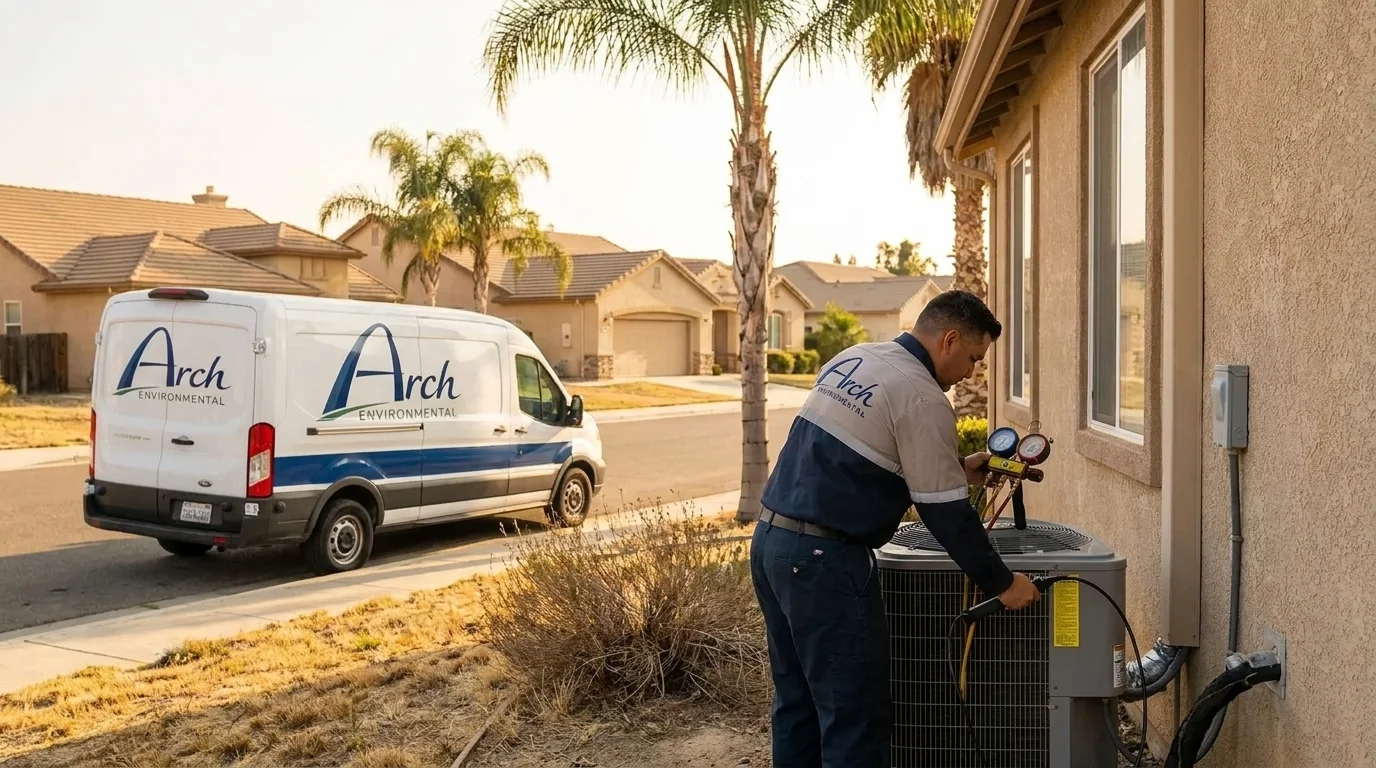
HVAC and Duct System Assessments in Kingsburg
Certified hvac and duct system assessments in Kingsburg and surrounding areas. Independent inspections, accredited lab analysis, clear written reports. Call (559) 296-2088.
When the same rooms feel stuffy no matter how long the AC runs, or when a musty smell returns within days of cleaning, the duct system is often where the investigation needs to start. Contaminated or poorly sealed ductwork can circulate particulates, mold spores, settled dust, fiberglass fragments, even rodent debris, through every room in a building without leaving an obvious trace at the register. An HVAC and duct system assessment identifies exactly what is moving through the air and why, before remediation or replacement decisions are made.
What HVAC and duct system assessments actually involve
This is not a filter swap or a visual peek at the return. A thorough air duct inspection examines the entire air-handling pathway: the air handler cabinet, coil surfaces, drain pan, supply and return plenums, flex duct connections, and the register boots where ductwork meets finished ceilings or floors. Each of those zones can harbor different contaminants, biological growth favors the coil and drain pan where condensation collects, while settled particulates accumulate in horizontal trunk lines and low-velocity branch runs.
Duct contamination testing typically involves swab or tape-lift sampling from inside duct surfaces, spore-trap air samples taken at the register and at the air handler, and in some cases bulk material samples when visible growth or debris is present. Samples are analyzed by an accredited laboratory, and results are interpreted against EPA and NADCA guidance thresholds. The deliverable is a written assessment report, not a verbal recommendation, that documents findings, photographs, sample chain of custody, and a scope of work if remediation is warranted.
Timeline for a standard single-system residential assessment runs two to four hours on-site, with laboratory turnaround typically adding two to five business days before a final report is issued.
Our process
-
Pre-inspection intake and system review. Before touching the equipment, we note the system age, filter type and change history, any prior water intrusion near the air handler, and the complaint pattern (which rooms, which seasons, what symptoms). This shapes where sampling effort is concentrated.
-
Visual inspection of the air-handling unit and accessible ductwork. We inspect the coil, drain pan, blower compartment, and duct interiors using inspection mirrors and, where geometry allows, a borescope camera. We document visible microbial growth, debris accumulation, liner deterioration, and unsealed joints that allow unconditioned air, or attic or crawlspace air, to enter the system.
-
Environmental sampling. Spore-trap air samples are collected inside the air handler, at representative supply registers, and at an outdoor background location for comparison. Surface samples (tape lifts or swabs) are taken from areas of visible concern. All samples are logged with location, time, and conditions, then submitted to an accredited laboratory under chain of custody.
-
Laboratory analysis and data interpretation. We review results against the outdoor background sample and against EPA and NADCA guidance. An elevated indoor-to-outdoor ratio, or the presence of water-indicator species like Stachybotrys or Chaetomium, changes the remediation scope significantly compared to a finding of ordinary settled dust.
-
Written assessment report and scope of work. The final report includes all sample data, photographs, laboratory certificates of analysis, and, where contamination is confirmed, a written remediation scope that a contractor can bid from or that an insurance adjuster can review. We do not sell the remediation, which keeps the assessment independent.
What separates a good HVAC air quality assessment from a bad one
The most common failure in duct contamination testing is sampling only at the register face, the point farthest from where biological growth actually begins. Mold on a register grille is often surface dust; mold on the drain pan liner or inside the air handler cabinet is a systemic problem. An assessor who does not open the air handler and inspect the coil and pan is missing the most likely contamination site in a system that has ever had a condensate backup or a refrigerant leak.
A second common shortcut is skipping the outdoor background sample. Without it, elevated spore counts indoors have no reference point, a high raw count in a building surrounded by agricultural fields or during a windy Central Valley day may be entirely outdoor-driven. Background sampling is what makes the data defensible.
Insurance adjusters reviewing HVAC mold inspection claims look for chain-of-custody documentation, an accredited laboratory report (not an in-house read), and a clear causal link between a covered loss event (typically a water intrusion) and the contamination found. An assessment that provides all three moves through the claims process faster and with fewer disputes.
Arch Environmental Group LLC holds a Certified Asbestos Consultant credential and NIOSH 582 Microscopist certification, relevant here because older duct liner materials and HVAC insulation can contain asbestos, and a microscopist-level review ensures that fiber identification is not confused with mold in mixed-contamination scenarios.
What does HVAC and duct system assessments cost?
Typical costs for HVAC and duct system assessments vary based on system size, the number of samples collected, and whether laboratory rush fees apply. Most homeowners pay within the ranges below for residential assessments; commercial systems with multiple air handlers will fall higher.
| Scenario | Typical industry range |
|---|---|
| Single-system residential assessment, no visible growth | $350 – $650 |
| Single-system assessment with surface and air sampling | $600 – $1,100 |
| Multi-system residential or small commercial | $900 – $2,000 |
| Assessment with asbestos fiber analysis (older duct liner) | $800 – $1,500 |
| Post-remediation clearance sampling, single system | $400 – $750 |
Every loss and system is different, and Arch Environmental Group LLC provides a written scope before any work begins so there are no surprises. Homeowners insurance may cover the assessment cost when contamination is tied to a documented covered peril, a burst pipe near the air handler, for example, but policies vary; your adjuster can confirm what your declaration page includes.
Seasonal and regional considerations
In the San Joaquin Valley, HVAC systems run hard. Cooling season stretches from late spring through early fall, which means coils and drain pans are wet for months at a time, the exact condition that allows mold to establish on duct liner surfaces. When systems are finally switched to heat in November, that growth dries and becomes friable, releasing spores into the airstream just as windows close and ventilation drops.
Kingsburg and the surrounding communities also sit in one of the highest agricultural particulate regions in the state. Field dust, pollen, and harvest debris load filters quickly, and when filters are bypassed, even briefly, that material settles into duct interiors. Homes built in the 1970s and 1980s in this area commonly used fiberglass duct liner that degrades over time, releasing fibers that can complicate air sample interpretation without microscopist-level analysis.
Service area
Arch Environmental Group LLC is based in Kingsburg and provides HVAC and duct system assessments throughout the surrounding San Joaquin Valley communities, including Fresno, Selma, Hanford, Visalia, Tulare, Reedley, and Clovis. City-specific service pages link back here for full process detail.
If musty air, unexplained respiratory symptoms, or a recent water event near your air handler has you questioning what your duct system is circulating, call (559) 296-2088 to schedule your HVAC air quality assessment.
Frequently Asked Questions
Does homeowners insurance cover an HVAC and duct system assessment?
What is the difference between an HVAC mold inspection and a standard home mold inspection?
How do I know if my ducts need testing versus just cleaning?
What does an elevated indoor-to-outdoor spore ratio actually mean in an air sample report?
Can older duct insulation materials contain asbestos, and does that affect the assessment?
Looking for the best hvac and duct system assessments company in Kingsburg?
Arch Enviornmental Group LLC provides hvac and duct system assessments in Kingsburg, CA and the surrounding area, and has served local property owners since 2026. Customers rate us 5.0 out of 5 stars across 34 Google reviews. Call (559) 296-2088 to schedule hvac and duct system assessments or request a free estimate.
Schedule HVAC and Duct System Assessments
Independent, lab-verified testing across Kingsburg and California's Central Valley.
Related Coverage
- Our Environmental Testing Services
- Contact Arch Enviornmental Group LLC
- HVAC and Duct System Assessments in Clovis
- HVAC and Duct System Assessments in Dinuba
- HVAC and Duct System Assessments in Fowler
- HVAC and Duct System Assessments in Fresno
- HVAC and Duct System Assessments in Reedley
- HVAC and Duct System Assessments in Sanger
- HVAC and Duct System Assessments in Selma
- HVAC and Duct System Assessments in Visalia