
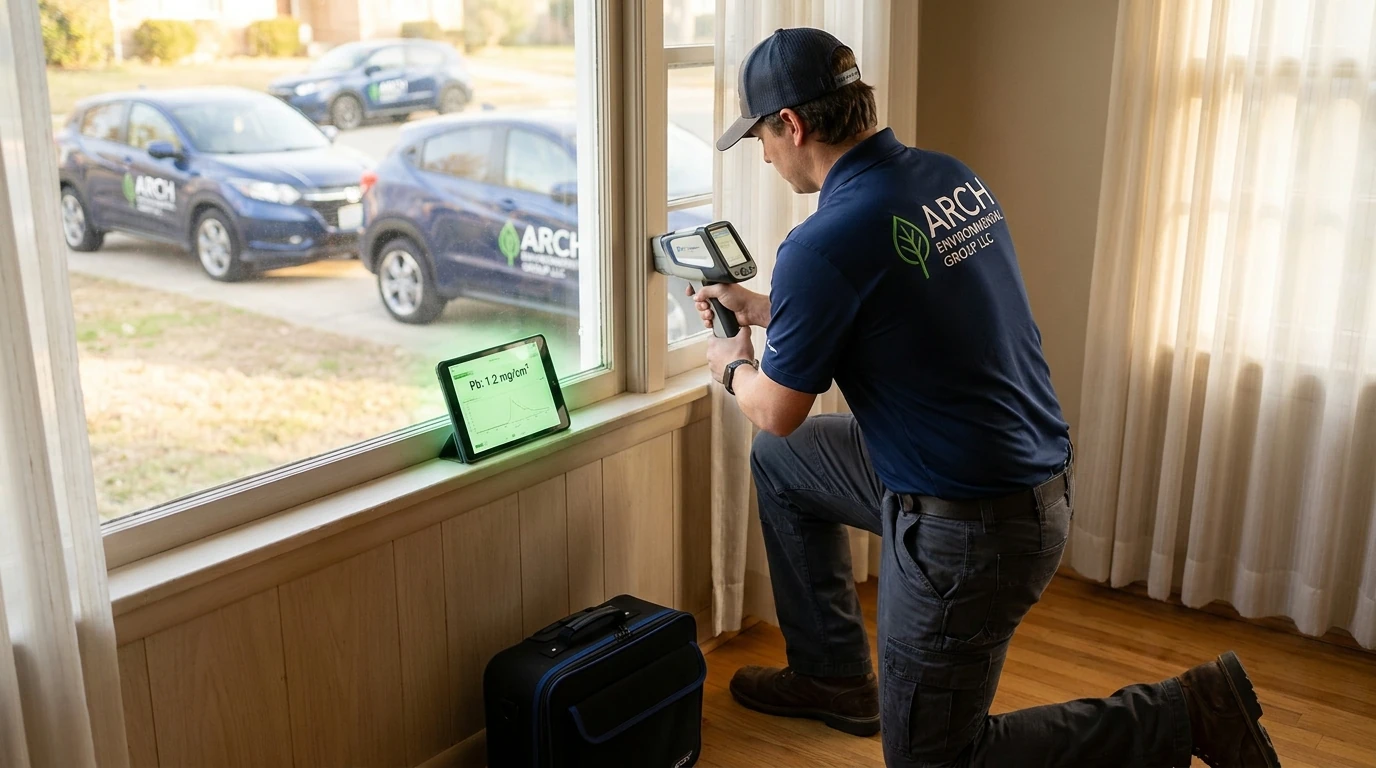
TL;DR: Lead paint testing in Kingsburg, CA involves an inspector using an XRF (X-ray fluorescence) analyzer or collecting paint chip samples to determine whether painted surfaces in a pre-1978 home contain lead at or above 1.0 mg/cm² (the federal hazard threshold). Results come back from an accredited laboratory within 24-72 hours. Testing is required before certain renovations and is strongly recommended during real estate transactions involving older homes.
If you are buying a 1960s bungalow near Kingsburg’s downtown Swedish Village district, or you are a landlord planning to repaint rental units built before 1978, the question is not whether lead paint might be present. In California, homes built before 1978 are presumed to contain lead-based paint until tested otherwise. The question is what condition it is in, where it is concentrated, and whether your planned work will disturb it. That is what a professional lead inspection answers.
What does lead paint testing actually involve?
A professional lead paint inspection uses one of two methods: XRF analysis or paint chip sampling. XRF (X-ray fluorescence) is a handheld device that reads lead concentration in painted surfaces in seconds, non-destructively. The inspector presses the analyzer against a surface, the device emits low-level X-rays, and the reading appears on screen in mg/cm². Paint chip sampling involves collecting a small physical sample from each suspect surface, sealing it in a labeled container, and sending it to an accredited laboratory for analysis by atomic absorption spectroscopy.
XRF is faster and covers more surfaces in a single visit. Paint chip sampling is required when XRF results fall in an inconclusive range (typically 0.7 to 1.3 mg/cm²) or when a specific surface needs laboratory confirmation. Most inspections use XRF as the primary tool, with chip samples collected only where the reading warrants it.
The EPA’s lead paint program sets the federal hazard threshold at 1.0 mg/cm² for XRF readings and 0.5% lead by weight for paint chip samples. California’s CDPH enforces these thresholds and maintains its own certification requirements for lead inspectors and assessors.
When is lead testing required in Kingsburg?
Lead testing is legally required in specific situations and strongly advisable in several others.
Required by law:
- Renovation, repair, or painting (RRP) work in pre-1978 homes and child-occupied facilities must follow the EPA’s RRP Rule. Contractors certified under RRP must test or presume lead is present before disturbing painted surfaces.
- Federally assisted housing (Section 8, HUD-funded projects) requires lead hazard evaluation before renovation and before a child under six occupies the unit.
Strongly advisable:
- Real estate transactions involving homes built before 1978. Sellers must disclose known lead paint hazards, but disclosure is not the same as testing. Buyers who want an objective, documented assessment before closing need an independent inspection.
- Pre-renovation planning for any owner doing window replacements, door casing work, or exterior repainting on an older Central Valley farmhouse or Craftsman-era home.
- Landlords in Kingsburg and nearby Selma or Reedley who manage pre-1978 rental stock and want documentation of surface condition before a tenancy begins.
If the home was built after 1978, lead paint is not a regulatory concern under federal law. If it was built between 1940 and 1978, the probability of lead-based paint is high: the CDC reports that approximately 87% of homes built before 1940 and 69% of homes built between 1940 and 1960 contain lead-based paint.
What does the inspection process look like?
A lead paint inspection in a typical Kingsburg residence follows a structured protocol.
- Pre-inspection review. The inspector collects the home’s construction year, any known renovation history, and the specific areas of concern (windows, doors, trim, exterior siding, interior walls).
- Component-by-component XRF testing. The inspector moves through the home systematically, testing each painted component type: window sills, door casings, baseboards, walls by room, exterior trim, and any other painted surfaces specified in the scope. Each reading is logged with the component, location, and result.
- Paint chip sampling (if indicated). Where XRF readings fall in the inconclusive range, or where the client requests laboratory confirmation, a small chip is collected, the area is stabilized with encapsulant paint, and the sample is sealed in a labeled chain-of-custody bag.
- Report delivery. The inspector compiles findings into a written report that maps each tested component, its XRF reading, and whether it meets or exceeds the hazard threshold. If chip samples were collected, the laboratory results are appended. Typical turnaround is 24-72 hours for the written report after the field visit.
The report is contractor-neutral. It documents what is present and where. The reader can take that report to any qualified lead abatement contractor for a remediation scope, or to a real estate attorney if the findings affect a transaction.
How do lead paint results affect a real estate transaction?
Lead paint findings in a real estate deal are negotiating data, not automatic deal-killers. A positive XRF reading on an interior window sill in intact, well-adhered condition is a very different situation from deteriorating lead paint on friction surfaces (windows that slide, doors that rub) where dust generation is ongoing.
A risk assessment, which goes beyond a standard inspection, evaluates not just the presence of lead paint but the condition of painted surfaces and the likelihood of lead dust or soil contamination. The risk assessment report can support a negotiation for a price reduction, a seller credit toward abatement, or a remediation contingency.
For buyers in Kingsburg with an option period closing soon, the sequence matters: get the lead inspection done early in the due-diligence window so the written report is in hand before you have to decide. A same-week appointment is typically available for residential properties in the Central Valley.
Once a transaction closes, if abatement is needed, a qualified lead abatement contractor (licensed under Cal/OSHA’s lead regulations) performs the work. After abatement, independent clearance testing confirms that lead dust levels meet the EPA’s post-abatement clearance standards before the home is reoccupied. Clearance testing should always come from someone other than the abatement contractor, for the same reason the original inspection should be independent: the person verifying the work should have no financial interest in the outcome.
What happens if lead paint is found?
Finding lead-based paint does not mean the home is uninhabitable or that immediate abatement is required. The regulatory response depends on the condition of the paint and the use of the space.
Intact, stable lead paint on surfaces that are not subject to friction, impact, or deterioration is generally managed through encapsulation (a durable coating that seals the lead surface) or enclosure (covering the surface with new material). A qualified contractor assesses which approach fits each component.
Deteriorating or friction-surface lead paint is the higher-priority concern. Chipping paint on a window sill in a child’s bedroom, or lead paint on a door that sticks and generates dust every time it opens, represents an active hazard. Abatement by a Cal/OSHA-licensed contractor is the appropriate response.
Lead dust and soil are separate from paint condition. A risk assessment can include wipe sampling for lead dust on floors and window sills, and soil sampling in play areas near the home’s exterior. These are particularly relevant for homes in older Kingsburg neighborhoods where exterior paint has been weathering for decades.
After any abatement work, independent clearance testing verifies the contractor’s work meets federal standards. This is the step that closes the loop and gives you a documented clean bill for the property.
For lead paint testing in Kingsburg and across the Central Valley, Arch Environmental Group LLC provides independent lead inspections and risk assessments with all samples analyzed by accredited third-party laboratories. Because the company does not perform abatement, the findings carry no remediation upsell. Schedule a lead paint inspection or call (559) 296-2088 to discuss your property’s scope.
About Arch Environmental Group LLC
Arch Environmental Group LLC is an independent environmental testing company based in Kingsburg, CA (2453 16th Ave, 93631). The company’s inspectors are certified as Lead Inspector Assessors and Certified Asbestos Consultants, and hold NIOSH 582 Microscopist credentials. Services include lead paint testing and risk assessments, asbestos testing, mold inspection, indoor air quality testing, radon testing, water quality testing, clearance testing, and a full range of environmental assessment services across Kingsburg, Fresno, Visalia, Selma, Reedley, and surrounding Central Valley communities. All field samples are analyzed by accredited third-party laboratories with chain-of-custody documentation.